







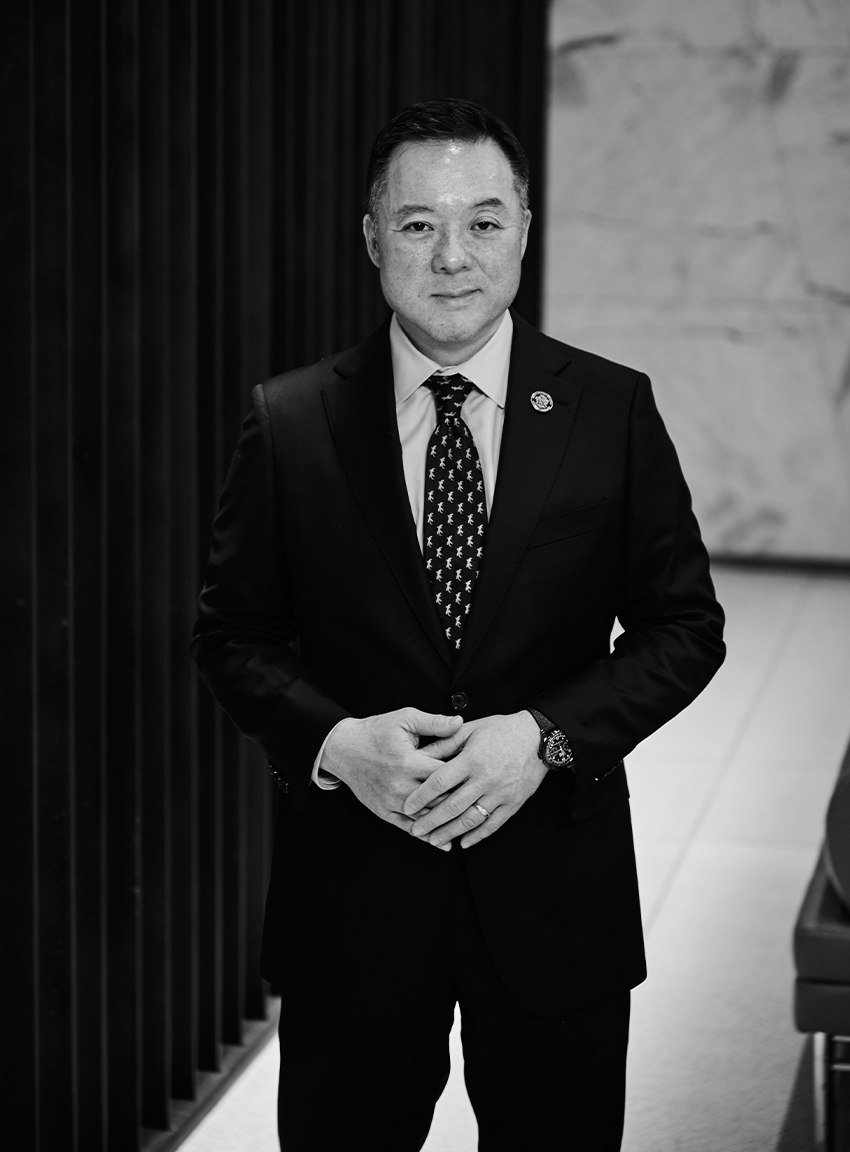
In 2019, William Tong was in his new office in Hartford, serving his first day as Connecticut’s newly elected attorney general, when his assistant came into the room. She said he had a phone call waiting. On hold was U.S. Senator Joe Lieberman, a Stamford native who had served as Connecticut’s attorney general in the 1980s.
Tong couldn’t wait to pick up the phone. At age 15, he had gotten his start in politics working for Lieberman’s first U.S. Senate campaign.
“He said, ‘Congratulations, I am so proud that 30-something years later, you are sitting in my chair at my desk, and you are attorney general,” Tong recalls.
Tong remains in the role of Connecticut attorney general today and is simultaneously serving as president of the National Association of Attorneys General. He drives to and from his Hartford office and his home in Stamford, which he shares with his wife, Elizabeth, and their three children. He says he is filled with gratitude for many things, including people like Lieberman and Stamford’s strong political network, which he says is a big part of the reason he got the job of attorney general in the first place
“I am attorney general because of Stamford,” Tong says. “Stamford is the most important political base in Connecticut, period. Full stop. I am very proud to be from Stamford, and to have all the weight and influence of Stamford behind me.”

Attorney General William Tong at his office in Hartford, Connecticut.
He didn’t always feel that way. In fact, he chose to go into politics because during the first part of his life, he felt completely unseen.
Tong’s parents immigrated to the United States from China and Taiwan. They owned and operated a restaurant in the Hartford area. Being part of its staff was Tong’s first job as a kid during the 1970s and 1980s, from when he was in the sixth grade. His parents worked 12 to 15 hours a day at the restaurant, where people would bring their families for sit-down dinners with the waiters in bowties and red jackets, back when going out for Asian food meant a whole lot more than picking up takeout.
The people in the dining room were having an excellent experience, he says, but the people hustling behind the scenes, not so much.
“I would be lying if I told you I enjoyed it,” Tong says. “When you grow up like I did, working with your parents, you watch them suffer. It’s backbreaking work. My mom carried five children to term on her feet, and frankly, only went to the hospital when it was time to give birth. My dad had a heart attack. My mom had permanent back damage. You just want to help them.”
There was a door, he says, between the kitchen and the restaurant, a demarcation line of sorts between the haves and have-nots. It had a diamond-shaped cutout where the staff could peer through and see how the other half lived.
“I would look through that door and see people who didn’t look like me,” Tong says. “They were having a good time, enjoying their Friday night dinner. I wanted to kick that door in and show them how hard my parents were working. That’s what drove me to public service.”
His overwhelming feeling, he says, was that he and all the people like him were invisible. That their work wasn’t recognized. That they were recognized only as servants, and nothing more. It’s a feeling that ate at him, so much so that at school, he volunteered for leadership positions. So much so that he went on to graduate from the University of Chicago Law School. So much so that he decided to go into politics, where people on campaigns like Joe Lieberman’s made him feel seen.
“That’s when I realized this was something I could do,” Tong says. “It was a place where I could fit in. They said, ‘Come here, work, volunteer, have fun with it.’”
Tong moved to Stamford after law school because he got a job in New York City, and Stamford was a good hub for a commuter. He attended a Democratic Party event at Taranto’s restaurant on Glenbrook Road, where he met another politician—a future governor of Connecticut—who also made him feel seen.
“I met the mayor,” Tong recalls. “I shook his hand and said I wanted to be involved, ‘would you be interested in having breakfast?’ That was Dan Malloy, and he said sure, which in its own way was amazing. He was already in his second term as mayor. He was already a big deal around town, and he was willing to have breakfast with some no-name kid right out of law school.”
They had breakfast at a restaurant called the Landmark, after which Tong started helping Malloy at campaign time, doing things like driving him around. Tong grew more and more interested and involved in politics, and felt determined that he should run for office.
“Some local leaders weren’t buying it,” he says. “No Chinese-American had ever served in Connecticut elected office at a state level. I think people were just having trouble getting used to the idea. They just couldn’t picture it. But Mayor Dan Malloy, to his credit, said, ‘William’s got a lot to give, and I support him.’”

Tong with Deputy Attorney General Eileen Meskill
In 2006, Tong ran for a seat in the state House of Representatives. “Everybody thought I would get killed,” he says. “That was a Republican seat, and it was previously held by a murderer’s row of Republicans. Really, really successful people. Michael Fedele from Stamford held that seat. Christopher Shays of Stamford held that seat. Chris Burnham held that seat. It was a Republican seat with a long and distinguished line, and for a Democrat to win that seat was impossible.”
Tong says he knocked on 6,000 doors and lost 30 pounds. That’s what it took to win and become the representative for Connecticut’s 147th district, which includes most of North Stamford. He’d go on to serve six terms, rising to become chairman of the Banking and Judiciary committees.
“At one point, I was the fifth living chairman of the Judiciary Committee from Stamford,” he says. “I was part of the team that wrote some of the strongest gun laws in our country.”
As chairman of the Judiciary Committee, Tong also worked on reforming the criminal justice system, improving civil rights protections and bringing marriage equality to Connecticut. At one point, he ran for mayor of Stamford, but lost in a close election. It was his run for state attorney general that led him to move on.
Shifting from being a committee chairman into the role of attorney general came with pros and cons.
“I love being attorney general. I’m grateful,” he says. “And I love being attorney general in this moment because so much is at stake, especially in our fights with the federal government. But I’m no longer a frontline lawmaker. I’m no longer chairman of the Judiciary Committee who gets to choose which bills we’re going to debate and which laws are going to be put up for a vote and be passed. That I miss, because that is one way that you can change the lives of people across this state.
“I get to do that as attorney general in different ways. As one example, I just fought for the thousands of residents of an apartment complex in Rocky Hill that got displaced in extreme weather. I brokered a $5 million settlement. I’ve saved Connecticut more than $2 billion in potential cuts to federal funding in the last year.”
Tong also has vowed to fight any court in any state where access to reproductive health care is under threat. He was the recipient of the 2026 Community Impact Award from Planned Parenthood of Southern New England last month.
Given his biography and career trajectory—including a bid for a U.S. Senate seat that Chris Murphy won—it’s natural to wonder if Tong might someday run for federal office. He says he’s focused on what he’s doing as attorney general in Connecticut right now, but adds: “The best way to get to another office, if that’s what history gives me, is to do a good job, and if I can, a great job, with the job I’m doing.”
When he does take a break from work, Tong can sometimes be spotted out on his 21-foot KenCraft boat, which he keeps docked at Cove Island Park in Stamford. Tong is a big fly-fisherman. “I love to go out in the Sound on my boat,” he says. “That’s how I find peace, fishing for bass and bluefish.”
People out on the water tying flies have a lot of time to think. And given all the challenges a state’s attorney general might be working on at any given time, Tong certainly has a lot that he could be thinking about.
But what stays forever in his mind, he says, is just how much the city where he lives has helped to shape the way his life is turning out.
“I’m from Stamford. I’m of Stamford. I feel the city and the people, and I carry them to Hartford every single day, and then I come home to Stamford every single night,” he says. “I’m grateful for the people of Stamford for taking a chance on me so many times. As the first Asian-American elected to any state office in Connecticut state history, there was just no guarantee that this could happen. Nobody looking at the son of immigrants would ever have said, ‘This kid could be attorney general.’”
Photography By Kyle Norton