





ACT ONE
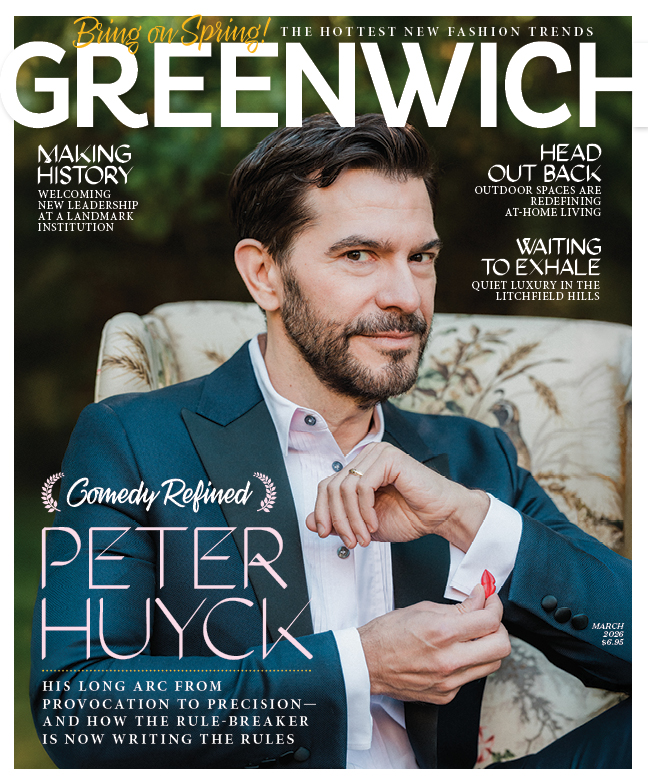
Among the most mischievous youths ever to spring from the loins of Greenwich was one Peter Huyck.
When I last encountered him, a quarter century ago at his parents’ lovely home in Belle Haven, he regaled me with tales of his knavery. It all began (he delighted to say) at Greenwich High School. He’d transferred there from the Brunswick School, whose strict jacket-and-tie ethos had suppressed the demon-jester in him. The thing was evidently dying to pop loose. And pop loose it did, as he surveyed epic scenes of anarchy at the GHS of 1987. “The water balloon fights and the mayhem and the streaking—that kind of stuff you just don’t get at other schools,” he’d told me with a nostalgic sigh.
Somehow, Huyck got put in charge of SRO, the senior class’s annual theatrical production. The show touched heavily on the delicate subject of headmistress Eileen Petruzillo’s iron-fisted rule—a rule that, to the dismay of many, dampened the school’s reputation for antic lunacy. One skit not aimed at the humorless headmistress vaulted well beyond the pale. It was a faux TV commercial—in the Saturday Night Live mode—for very large diamonds. Huyck persuaded a bevy of young beauties to take off every stitch of clothing, save the essential bits, and to lasciviously stroke a diamond as big as a softball. (Now that one thinks of it, one can see how this sketch chafed a Greenwich nerve.) He filmed the commercial at his house while his parents—the eminently decent Philip and Mary Huyck—retreated to the wings, clutching their foreheads.
“It was as near to pornography as we could do in high school,” their son fondly reminisced. When the time came to show his handiwork to a packed house on opening night, Huyck planted himself among parents and grandparents and other innocent parties in the auditorium, the better to gauge their reaction. “I remember thinking, ‘This is going pretty good.’ Just then, the cheerleader coach comes storming up the aisle and out.” Huyck slapped his thigh at the memory. Outrage was mother’s milk to him. “If people didn’t get up in arms, what would be the point?”
In 1994, Huyck fetched up at Spy magazine. Do you remember Spy? The satirical magazine reveled in afflicting the comfortable—the tasteless rich, the unjustly famous, the curiously influential. These folks duly feared being mentioned in Spy’s remorseless pages. (“It’s a piece of garbage,” said Donald Trump.) Huyck, along with his creative partner, Alex Gregory, was hired as a sort of cultural guerrilla, a merry prankster who baited Republican congressmen into disparaging First Lady Hillary Clinton’s looks (“She wouldn’t pass the Bono test”: Sonny Bono). Who got Christian bigwigs Jerry Falwell and Ralph Reed to answer dopey questions like, “Who would win at one-on-one basketball—Charles Barkley or Jesus?” (Both said Jesus.) Who conducted interviews on weighty subjects with phone sex operators. (“Milton Friedman makes me hot,” one confessed.) Who set themselves up as the editors of Cue Ball, a “bald pride” magazine that phoned celebrity publicists purporting to have, with plans to publish, candid photos of their richly coiffed clients without their toupees on. (Fabio’s man was apoplectic: “The next time he has an appearance, go by and see him and pull on his hair, OK?”)
Huyck and Gregory’s boss at Spy, Owen Lipstein, offered frank insight into the duo’s sociopathic chemistry. “I’d describe Pete as having a truant disposition. And he’s perfectly willing to do the lowbrow stuff, the fart jokes. Alex is more thoughtful, more melancholy.” This rare admixture—lawless effervescence and droll misery—proved shockingly remunerative. In 1996, Huyck and Gregory ascended to the writing staff of Late Night with David Letterman—a particular coup for Huyck, who, as a boy, after the other Huycks had gone to bed, would sit at his mother’s portable kitchen TV and imbibe the quirky Letterman humor.
“I just remember him being the guy that I wanted to be, wanted to work with, wanted to write jokes for—anything,” Huyck recalled. “Dave was my guy.”

Last September, The Studio collected 13 Emmys, a record for a comedy series. Huyck, pictured with Seth Rogen, won for Outstanding Writing and Outstanding Comedy Series.
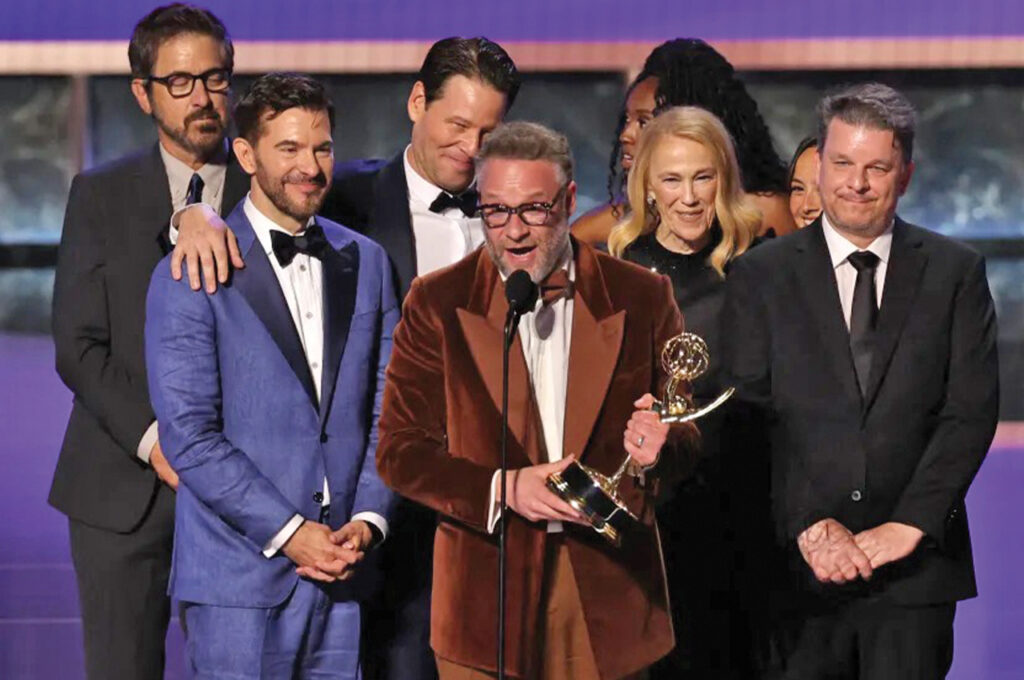
The cast and crew Huyck, Rogen, late actress Catherine O’Hara and co-creator Alex Gregory; Executive Producer James Weaver, actor Ike Barinholtz, co-creator Frida Perez and actress Chase Sui Wonders
Ever adventurous, Huyck and Gregory left Letterman after 18 months for their first sitcom gig, The Larry Sanders Show, starring Garry Shandling. Do you remember Larry Sanders? It was a sitcom about a talk show—a show about a show. Its audience was smallish, but its influence was huge, making Larry Sanders a sort of Velvet Underground of sitcoms. Shandling concocted an awkward, uncomfortable style of humor that today we call “cringe.” “This is where it all began,” noted The Guardian. “The whole postmodernist, self-reflexive, fact-fiction sitcom thing.” Shows like The Office, Curb Your Enthusiasm and Modern Family are its direct heirs.
The timing of Huyck and Gregory’s switch from printed word to TV screen—just as America had begun to jet-propel itself out of the literate age—was flawless. Flawless except for the fact that Shandling decided to end Larry Sanders after six brilliant seasons, but only one for Huyck and Gregory. Were they finally due for a stumble? No. Like mountain goats that skip adroitly from crag to crag, Huyck and Gregory landed at Frasier, then the most popular sitcom on television.
And that’s where I left the Peter Huyck story all those years ago.
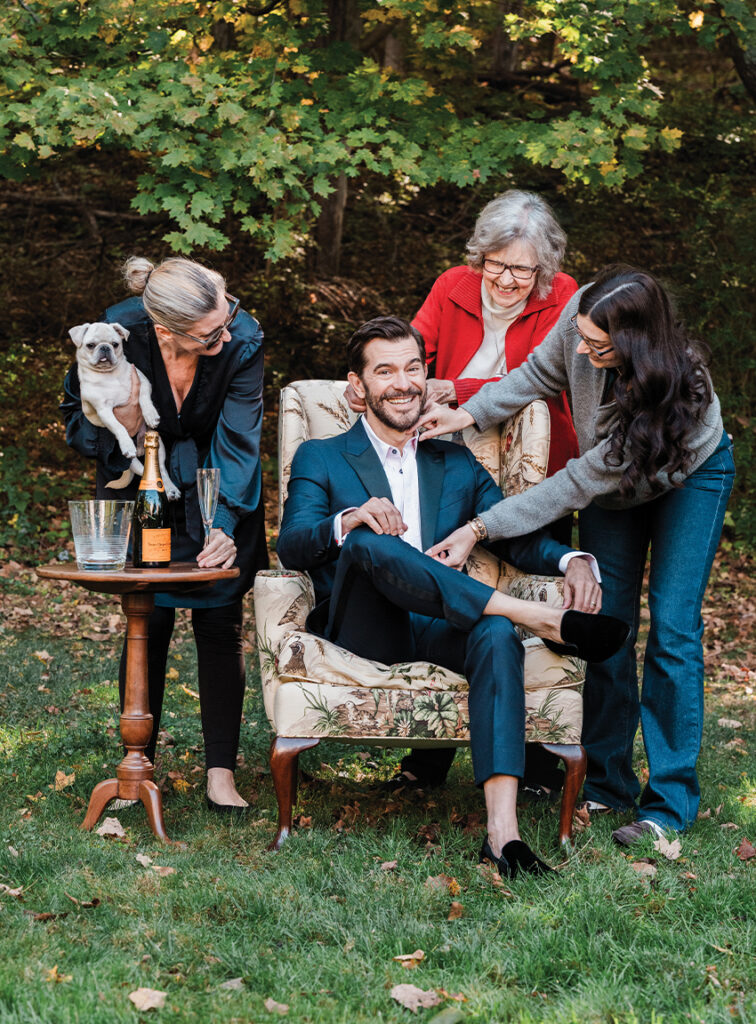
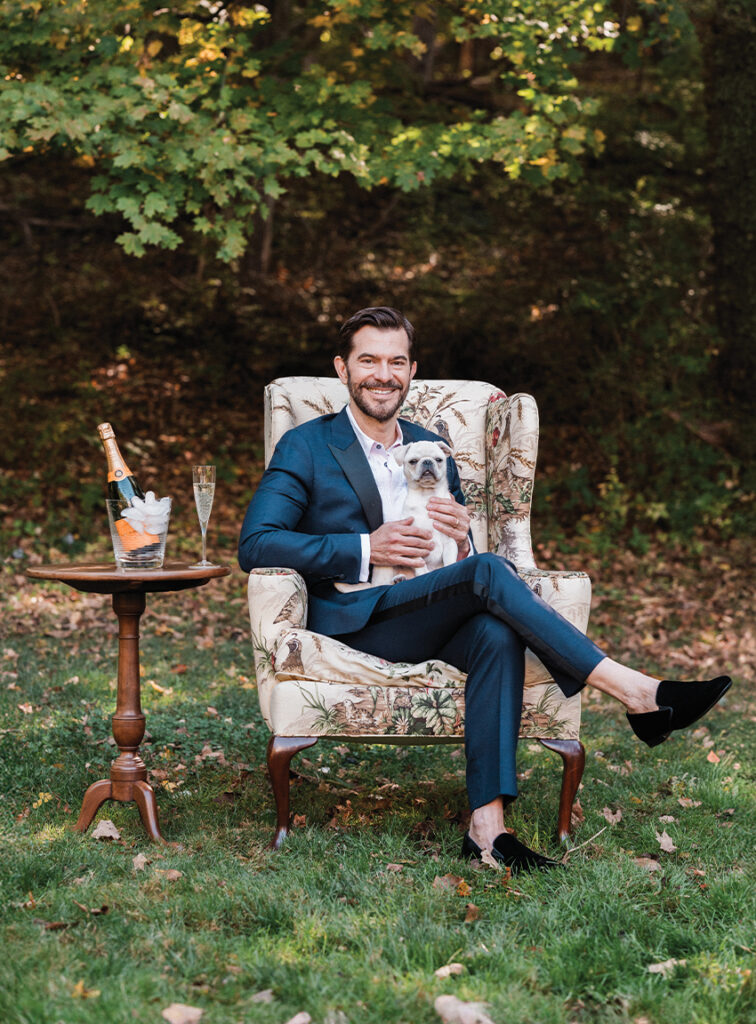
The Huyck women attend to their guy—Peter’s sister Laura Redican with her pup Martin, mother Mary and wife Jessica.
ACT TWO
I saw him next on September 14, 2025. I was watching the 77th Primetime Emmy Awards, coming to us live from the Peacock Theater in Los Angeles. A new sitcom called The Studio, from Apple TV+, was pummeling the competition: It won 13 Emmys, an all-time record for a comedy series. When the presenters announced that, amid this avalanche of gold, The Studio had won for Outstanding Writing for a Comedy Series, who should come bounding onto the stage but Huyck and Gregory? With them were Seth Rogen, Evan Goldberg and Frida Perez. This quintet not only wrote the show, but created it as well; and Rogen and Goldberg (a longtime creative duo themselves) directed all ten episodes.
Rogen is the big name here, having acted in such humongous moneymakers as The 40-Year-Old Virgin, Knocked Up, Pineapple Express and Neighbors, and co-written Superbad, This Is the End and Sausage Party. Longtime Rogen-watchers will know him chiefly for a strain of comedy that features goofy, sex-addled man-children.
In The Studio, Rogen gives us someone considerably more high-toned. He gives us Matt Remick, a fellow who, though not quite a Hamlet, rates quite high on the conflictedness scale. As an executive at Continental Studios, Remick is caught in the classic Hollywood bind: to make art or to make money? He’s an art man himself (“Film is my life”), but new CEO Griffin Mill (played by Bryan Cranston) hasn’t an artistic bone in his body. He’s all commerce: “At Continental we don’t make films, we make movies.”
In the first episode, “The Promotion,” Mill abruptly fires studio head Patty Leigh (Catherine O’Hara), Remick’s cherished mentor, after she’s put out a string of bombs. Does Remick quit in protest? Does he stick up for Patty’s vision of film-as-art? No. He lobbies for her job. His conscience is further stretched when Mill announces that he’s secured the rights to “the legacy brand of Kool-Aid.” We catch Remick’s look of bafflement as he wonders what the devil a Kool-Aid movie might be. Lest Mill sniff out the art-lover in him, though, Remick quickly embraces what he knows to be a terrible idea—and is rewarded with the coveted promotion. Thus begins Matt Remick’s comedy of answered prayers.
Critics adored The Studio’s debut season. At Rotten Tomatoes it scored 93 percent fresh. The Los Angeles Times, The New York Times and The Washington Post all bestowed raves, as did Variety, Rolling Stone and Time, which called the show “one of Hollywood’s sharpest self-portraits in ages.” And what is the essence of that self-portrait? “A collective middle finger to the system, sent with love,” according to RogerEbert.com.
On Emmy night, I leaned forward when Huyck stepped up to collect his share of the writing prize. “I know that guy,” I said to my wife. She shushed me. Huyck was now 52, no longer a whippersnapper, but he barely seemed to have aged. (Green tea, blueberries and a daily skincare regimen are his secrets, according to Jessica Clements, his lovely, mystique-busting wife.) Still athletically lean, still perpetually sunny despite the ravages of Hollywood, the only real change I noticed was the addition of some neatly trimmed facial hair. Arrayed in his gala finery, Huyck resembled nothing so much as a hip Dutch count.
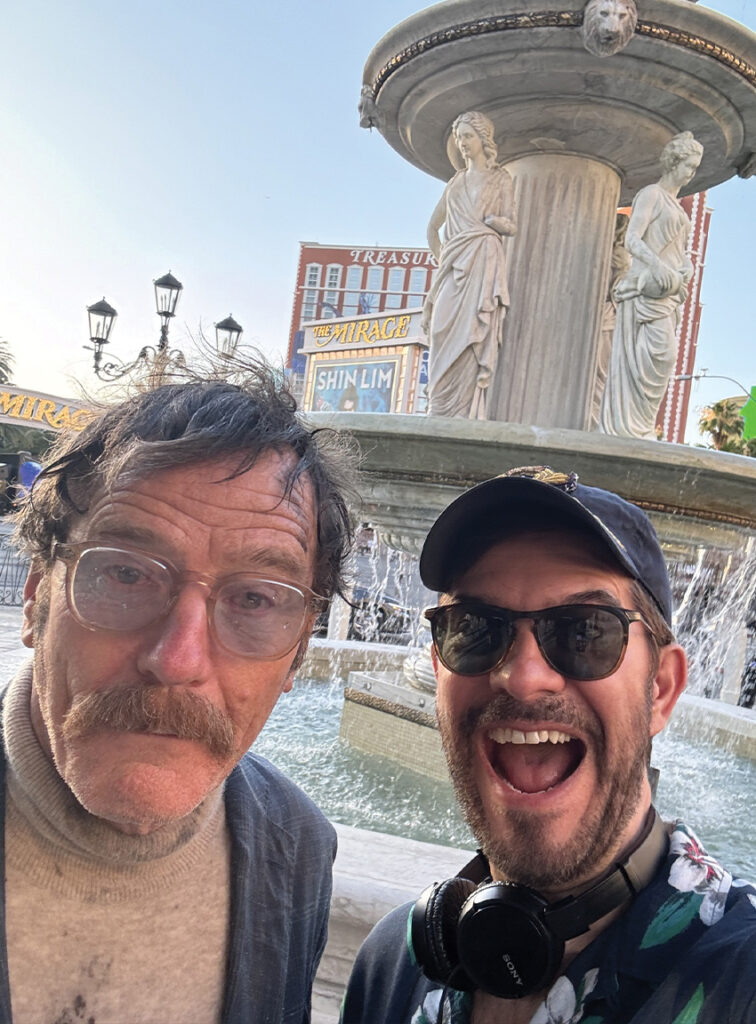
On the set of The Studio with Bryan Cranston

Behind the scenes of The Studio: The late Catherine O’Hara, Peter and editor, Eric Kissack

Olivia Wilde, Seth Rogen, James Weaver and Peter on set while filming an episode Peter wrote titled “The Missing Reel.”
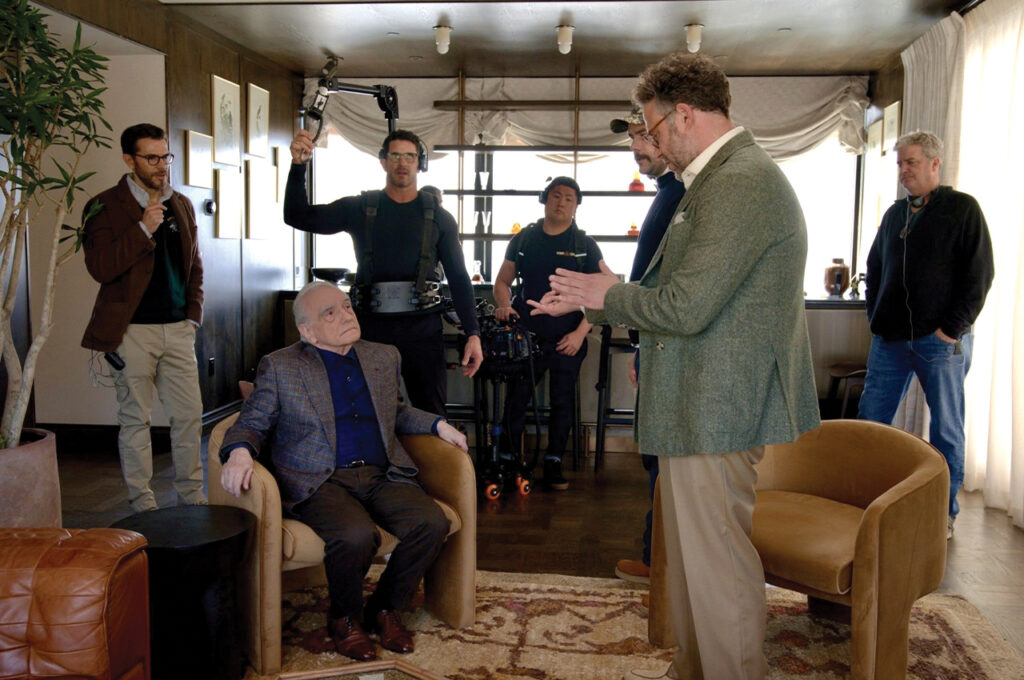
Peter and the other creators never thought they’d get Scorsese to play himself in the first episode. Pictured here, from left, are Peter, Ike Barinholtz, who plays Rogen’s sidekick Sal Saperstein, Rogen and Scorsese.
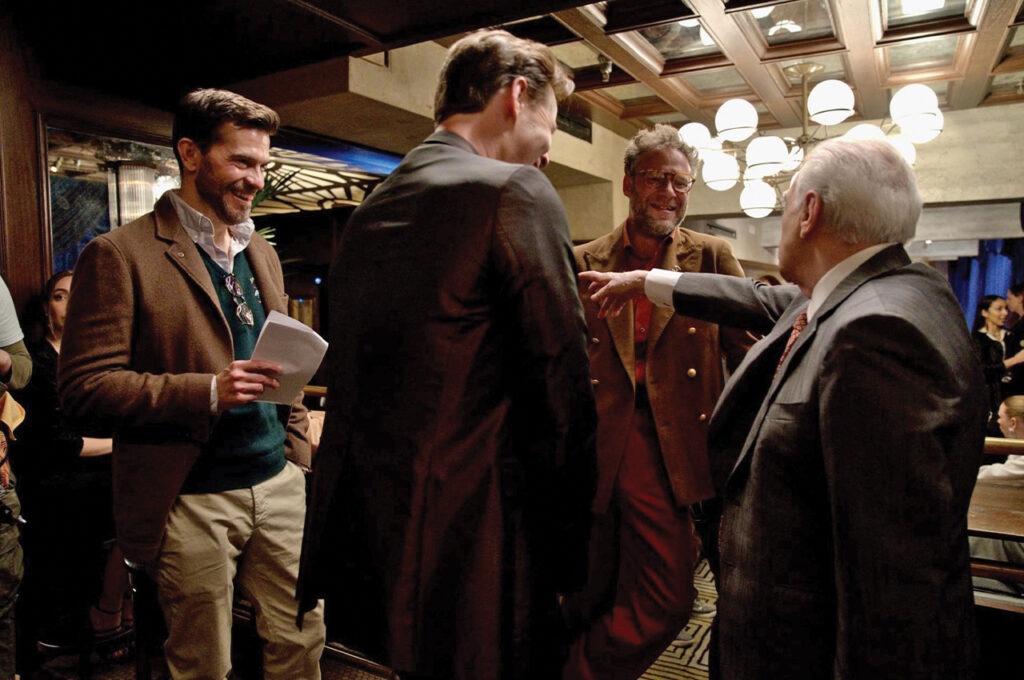
Filming with Scorsese
Three weeks later, I saw him in person, at his mother’s house at West Lyon Farm in Greenwich. He was sitting outdoors, on the grass by a lake, in the embrace of a toile-upholstered wingback chair. He wore a blue tux (no socks), as if the Emmy after-party were still burbling on. He had a bottle of Veuve Clicquot at his elbow and an adorable French bulldog pup, Martin, in his lap. Standing nearby were the three crucial women in his life—wife Jessica, mother Mary and sister Laura—as a photographer etched the moment in time. This mise-en-scène, created by Huyck himself, projected a not-untrue aura of bankable, devil-may-care eccentricity. It also bore a genetic trace of his grandparents Martin and Marie, the first Huycks to touch on the movie business. They used to dress up like stars, ride their tandem bicycle—silk scarves trailing behind—to Universal Studios, sneak onto the lot and picnic in the shadow of the Psycho house, waving to tourists who tried to puzzle out who they were.
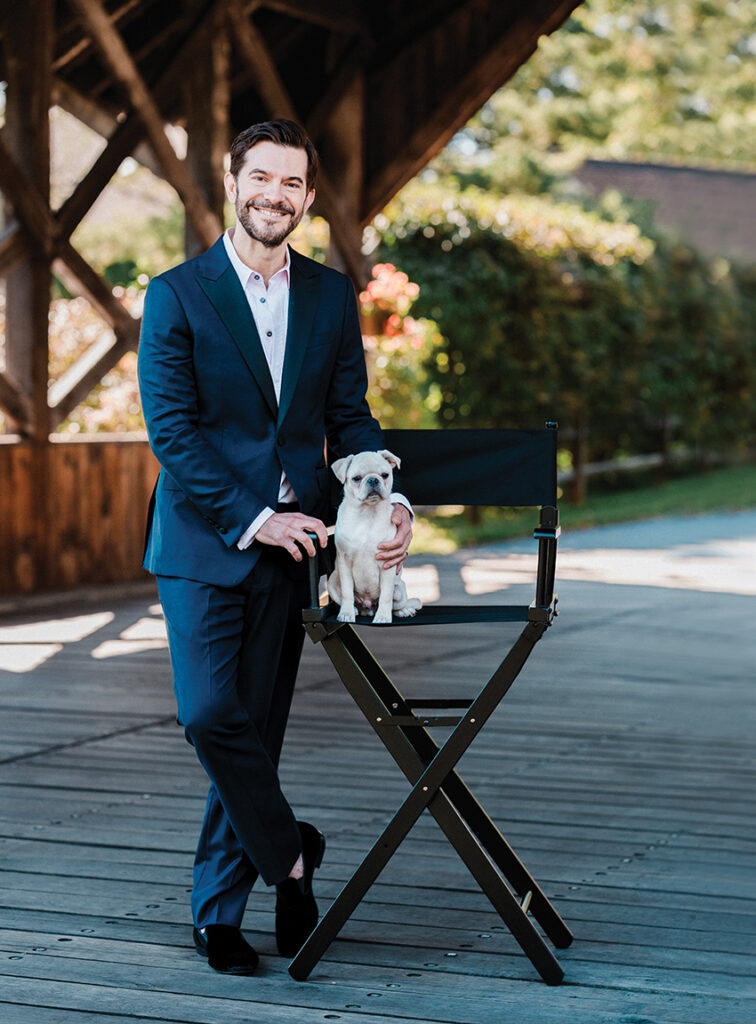
After the image-making portion of our visit was done, Huyck repaired to the living room for the interview portion. It had been a heckuva year. There was the delirious high of the The Studio’s success. Also the sale of a Christmas film pitch, Foster the Snowman, to Apple after a frenetic bidding war. (Huyck had drawn the inspiration from watching Will Farrell in Elf with his brother, Jon, and Jon’s two boys. “It’s a beautiful movie. But you realize it’s been 20 years, and no one has made that kind of big, beloved Christmas movie since.” His partner on the project is the screenwriter Jono Matt.)
Then a crushing low: the death of his father, Philip, from pancreatic cancer, in June. Peter had dropped everything to be at his side. Laura recalled, “We’d be going through the darkest, hardest day, when all anyone could do was cry, and Peter would find a way to make us laugh. When you hang out with Pete, you don’t need Prozac.” Philip got to see the whole first season of The Studio and to hear the news about Foster the Snowman.
The story of this prospective film is lovely but heartbreaking, so far as I can tell. It concerns a childless couple who adopt an adorable snowman and pack every joy and fear of parenthood into their little snowman’s brief life—72 hours. “I told my father the story, and we both cried, because it’s about how long your life is—and how you measure it.”
Maturity is the bane of the prankster. Whither the mischief? Whither the deviltry? In Huyck’s case, these things are not gone, but rather have been tempered in the forge and hammered into a new shape, a more graceful weapon. One that cuts ever deeper into life’s absurdities. In short, the prankster has become an artist.
ACT THREE
This dawned on me midway through the first episode of The Studio. So far, we have Griffin Mill’s vision of movies based on popular brands—or intellectual property—raking in billions of dollars. And then we have Remick trying to convince himself that such movies can still be art. But Kool-Aid? With its anthropomorphic pitcher of red liquid that bursts through walls bellowing “Oh, yeah!”?
Oh, no. And yet.
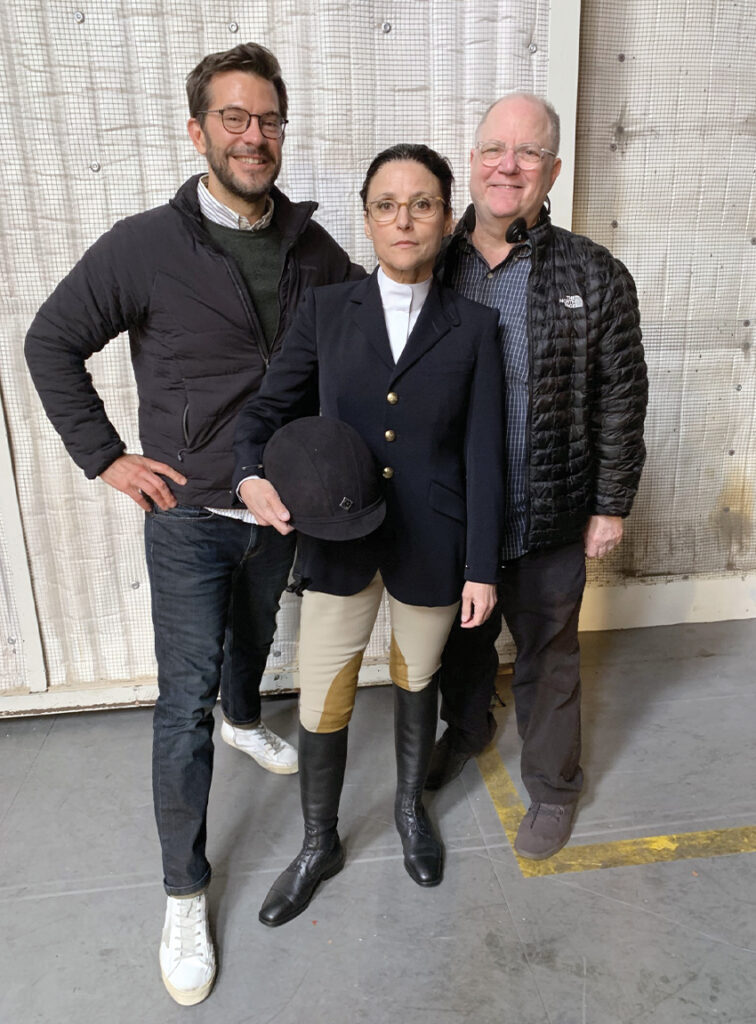
On the set of Veep with Julia Louis-Dreyfus and Executive Producer Frank Rich
“As we were developing the show, Barbie came out. And it actually was great. And it actually did make a billion dollars. So, we put that into Matt’s head—that there’s a world in which you can have this perfect movie from an auteur, and it is also IP [intellectual property] and can make a billion dollars.”
It is then that Martin Scorsese—the real Scorsese—comes to Remick seeking financing for his magnum opus. This film will be dark. It will be disturbing. It will be violent, naturally. “What’s it about?” asks Matt. “Jonestown,” says Marty. “Granted, it’s fucked up.” We remember, of course, that Jonestown was a settlement in deepest Guyana led by the messianic nutcase Jim Jones. In 1978, Jones induced his flock of 900 to end their lives by—we’ll let Remick say it: “Now, correct me if I’m wrong, is that the massacre where everyone commits suicide by [pregnant pause] drinking Kool-Aid?” For a brief and shining moment, Remick imagines he’s hit upon a way to turn bad IP into great art. (I won’t tell you how the episode shakes out, in the hope that you’ll watch it yourself.)
Huyck & Co. believe that Providence played a role in the episode clicking together so neatly. (This is the one that won the writing Emmy.) They did not imagine, for starters, that Scorsese would consent to playing this version of himself. They just wrote him into the script as a kind of dream-get. Once he did consent, they worried he would back out, and when he didn’t back out, they worried he would find fault with their shooting style: “You’re only using one camera? You don’t have a second? This is catastrophic! You’re idiots!” That’s the Scorsese that went tearing through their daydreams. What Scorsese actually said was, “Huh. One camera. Like French New Wave. I love it! It’s run-n-gun! Let’s go!” (The look of The Studio, it should be noted, is appropriately sumptuous, full of golden light and sexy architecture.)
Scorsese the actor could have been stiff and dull, but in fact he’s aces. After he finished playing a key scene, Huyck overheard him saying, “That’s the most fun I’ve had in forever.” The words fell out like a blessing. “At that moment, I think we all relaxed with this sense of, ‘OK, if we can have a scene with Martin Scorsese and he has a great time, that means we’re doing something right.’”
Real Hollywood folk crash the fictive world of The Studio with abandon. An episode titled “The Note” has the execs previewing a new Ron Howard film called Alphabet City. It’s fabulous, they agree, as the film draws to a climax. But then it keeps going. And going. And going. Who’s gonna be the one to tell Ron Howard to cut it—to tremblingly give him “the note”? To make matters worse, this “real” Ron Howard is no affable Richie Cunningham. No. He’s a “bald prick” who’s not above violence. “We thought,” said Huyck, “What’s funnier than Ron Howard with a backstory that he’s a very irritable guy who actually can be dangerous?”
In “The Oner,” Remick visits the set of The Silver Lake, a drama directed by Sarah Polley and starring Greta Lee. Polley is shooting an exquisitely delicate scene—a “oner,” a long, unbroken sequence—at that precise hour of the day when sunset is at its most gilded. It’ll be a historic shot, Remick insists, like the oner that winds through the Copa in Goodfellas. And it’s his prerogative as studio head to witness it. He proceeds to ruin take after take, first with a mere whisper, then with serial blunders that rise to a Chaplinesque pitch as valuable daylight leaks away. (“The Oner” is itself a oner. In a case of life imitating art imitating art imitating life, the daylight was in fact leaking away.) The episode won raves, and Roger Ebert’s site called it “possibly the year’s best television episode to date.”
I watched the credits roll: “Written by Peter Huyck.”
Later, I asked him about “The Oner.” “Writing that was harder than any episode of anything I’ve ever written. It was almost like math.” He meant that since the camera never stops, words and movement have to flow together in a perfectly measured choreography. “You couldn’t have an extra line of dialogue or too little dialogue.” On-set, Huyck said, everyone could sense the mojo working. “We all felt, ‘This is special, whatever is happening now.’ We felt like we were catching lightning in a box.”
ACT FOUR
The road to The Studio was not as straight or smooth as one might suppose, given Huyck’s charmed beginnings. From Frasier, he and Gregory leapt to the popular animated sitcom King of the Hill. After that, however, our mountain goats faltered a little. They went to the short-lived Tracy Morgan Show, then to the shorter-lived sitcom The Jake Effect (cancelled by NBC before the first episode ran). Their foray into writing and directing for the big screen, A Good Old Fashioned Orgy (2011), starring the otherwise can’t-miss Jason Sudeikis, drew mixed reviews and seems to have lost bags of money. Capping this slide toward oblivion were three Huyck-Gregory network pilots that were filmed but failed to butterfly into series.
Not to say that any of this work was subpar. The cheerfully jejune Orgy, which in spirit harks back to H&G’s prankster days at Spy, has its rabid fans. (Online comments run the gamut from “One of the very funniest movies I’ve ever seen” to “Contains 143 profanities.”) The Jake Effect, starring Jason Bateman as a lawyer-turned-teacher, eventually aired on Bravo to excellent reviews. Huyck himself holds affection for the three pilots, especially The Pro (2014), starring Rob Lowe as a tennis instructor much like those he knew while working at the Milbrook Club as a teen. No doubt some exec like Matt Remick, sitting in an office like that of The Studio, said “nay,” and something beautiful died.
In 2016 Huyck and Gregory landed at Veep—the hit political sitcom starring Julia Louis-Dreyfus—as writers and executive producers. H&G, fitting neatly into the show’s laugh machinery, were nominated for four Emmys and won two in their three seasons there. But they aspired to yet loftier crags. They wanted to be writers and producers and creators—to build something of their own—to be showrunners.

Peter, Rob Riggle with his double, Rob Lowe with his double and a set extra during the filming of the NBC pilot The Pro, which never aired. The show was loosely based on Peter’s memories of working at the Milbrook Club as a teen.
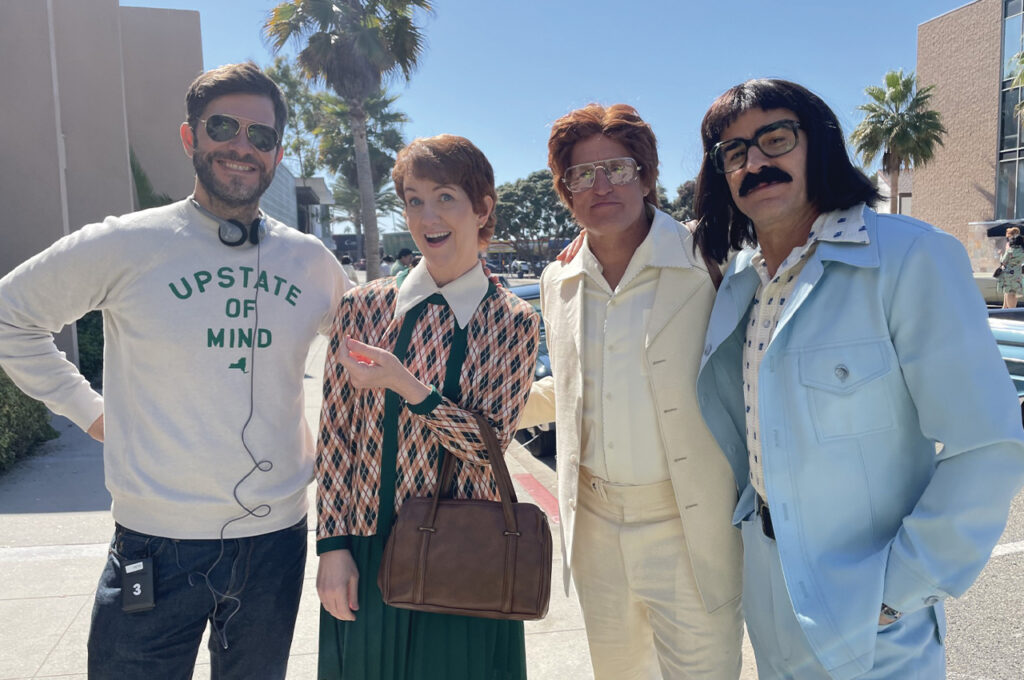
Peter with actress Deb Hiett, Woody Harrelson as E. Howard Hunt and Justin Theroux as G. Gordon Liddy in disguise
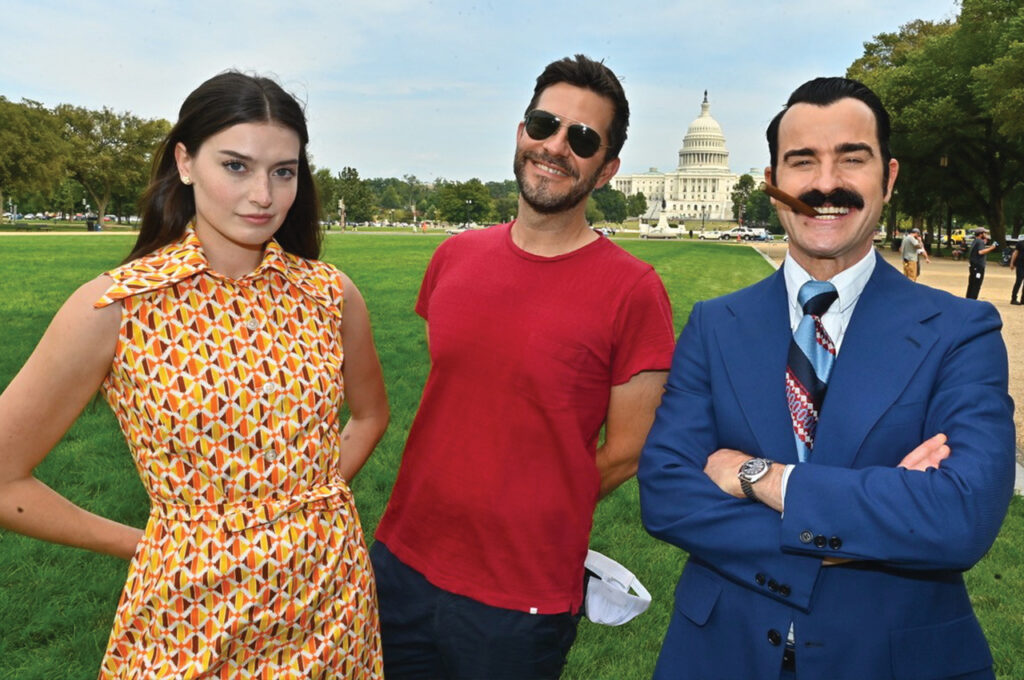
Jess, Peter and Justin Theroux (as G. Gordon Liddy) make a partly lovely, partly curious spectacle on the National Mall
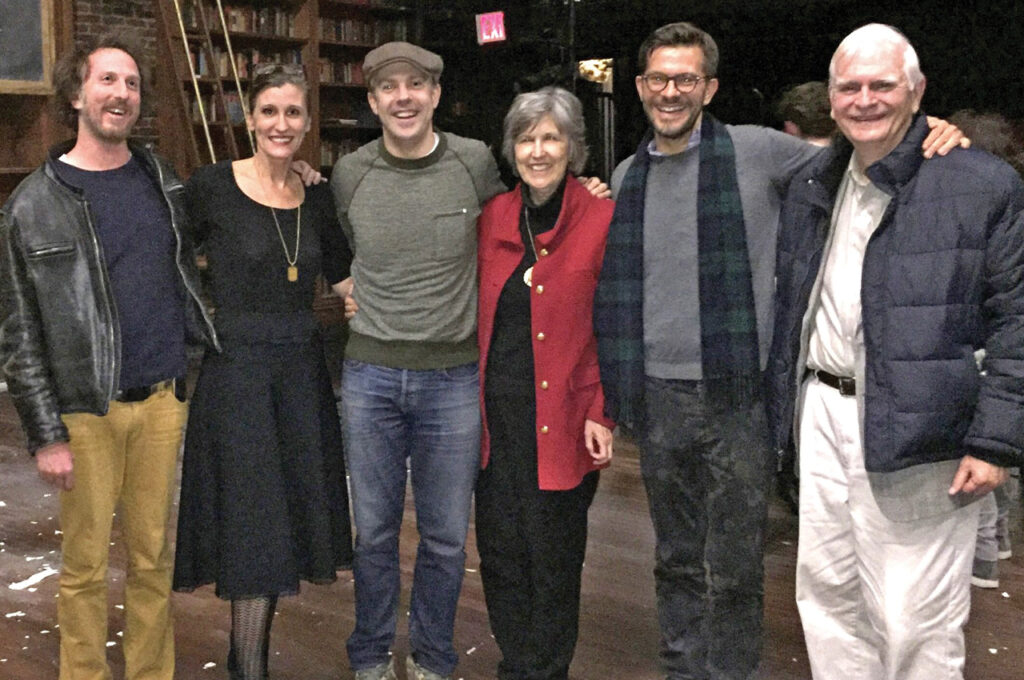
Ryan Miller (from the band Guster), Peter’s sister Laura , Jason Sudeikis, Peter’s mother, Peter and his father after Sudeikis’ performance in the play Dead Poets Society

Peter and Jess with Judd Apatow backstage at a comedy show
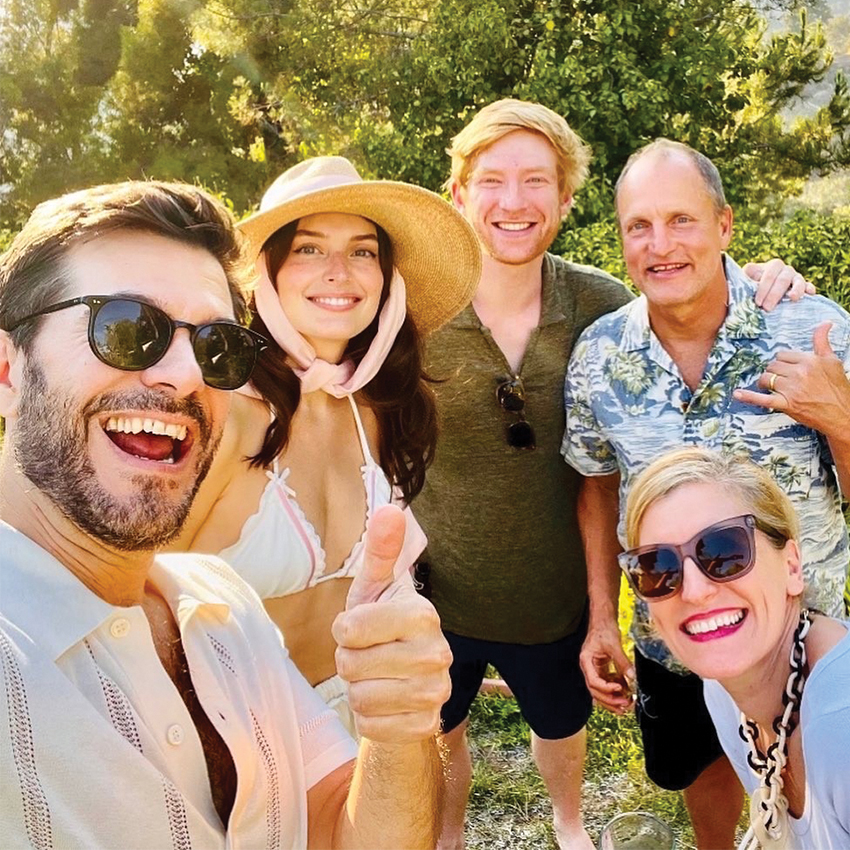
Peter, Jess, White House Plumbers actors Domhnall Gleeson and Woody Harrelson, Laura
They seized upon the rich material that is Watergate. “We were finishing Veep right as politics in America was getting uglier,” Huyck said. “It had lost any patina of respect or decorum and descended into daily mudslinging.” A Watergate story with a dose of comedy seemed a good way to reflect, however slantwise, this current broken America. Robert Altman used a similar strategy in M*A*S*H, a 1970 film set in Korea that seems to be about Vietnam. “You can tell a modern story through a historic lens,” Huyck went on. “M*A*S*H allowed Altman to talk about war without saying, ‘Here’s what’s currently happening,’ which people were not so ready to explore. For us, Watergate was a way to show the beginnings of the cracks in our political system. To show that people were willing to do illegal things for what they thought was the right team. And if you were on the right team, you couldn’t be wrong. That was the belief. But they were caught.”
The six-episode White House Plumbers debuted on HBO in 2023. The story concerns Nixon operatives E. Howard Hunt (Woody Harrelson) and G. Gordon Liddy (Justin Theroux), the bungling architects of the 1972 break-in at Democratic National Committee headquarters. The Watergate burglary constituted the domino that, in falling, took down the Nixon White House. But Huyck and Gregory bring out a sadness behind the bungling, chiefly in the ill-fated Hunt family. (Hunt’s wife, Dorothy, died in a plane crash in 1972 while carrying $10,000 in alleged hush money.) Some reviewers borrowed Tennessee Williams’s useful term “slapstick tragedy” to describe White House Plumbers. With H&G now bordering on the tragic, even the slapstick kind, we can mark an intriguing expansion in their range. Humor wasn’t just about laughs anymore; it was also social critique, an X-ray (with funny bone) of cultural disintegration.
One day, H&G were filming Plumbers at a prison in upstate New York. Harrelson and Theroux, who are like brothers with a bit of golden retriever mixed in, were engaged in their usual hijinks. In the show, Harrelson’s Hunt suffers a medical crisis, and Theroux’s Liddy must hoist him up and carry him off to the prison infirmary. Only, unbeknownst to Theroux, Harrelson had strapped weights to his limbs and torso, adding some 70 pounds to an otherwise medium frame.
Around the time Theroux was groaning, “Oof, what the—?” Huyck’s phone rang. It was Evan Goldberg. Huyck and Gregory had known Goldberg and Rogen for many years and had worked with them on scripts. (Their friendship ties back to Judd Apatow, who was a writer at Larry Sanders when H&G arrived, and later directed Rogen in the TV show Freaks and Geeks and in the films The 40-Year-Old Virgin and Knocked Up.) “We have an idea you guys might like,” Goldberg said. “Seth plays a guy who runs a movie studio, and in our minds it’s very inspired by Larry Sanders.” The tone would be perhaps warmer. “It’s about the industry, sure, but it’s really about humans. About emotion. But also funny.”
PLEASANT INTERLUDE
This, too, is about emotion, but also funny. It’s the Peter and Jessica love story. It commenced with a gathering on Thanksgiving 2018 at a mutual friend’s rental place in Costa Rica. A French chef had been hired to prepare the feast. But this feast, this magnificent duck, had to rest uneasily while everyone waited with dwindling patience for Pete to arrive. True, his flight had been delayed, but once in the country he texted a photo of himself having a beer with his cabbie. Then a photo of himself eating ice cream with the cabbie. Then a video of the cab careening down dirt roads and into creek beds and …
The chef stormed off. The Thanksgiving Day celebrants ate in silence.
It was then that Huyck made his cheerful entrance. He brandished bottles of tequila and pumped his fists in the air—the instantaneous life and soul of the party. Jessica, a porcelain-skinned model and beauty influencer with a dusting of cinnamon freckles on her nose, looked at him and thought, “Who does this guy think he is? He’s so annoying.” Pause. “But also very cute.”
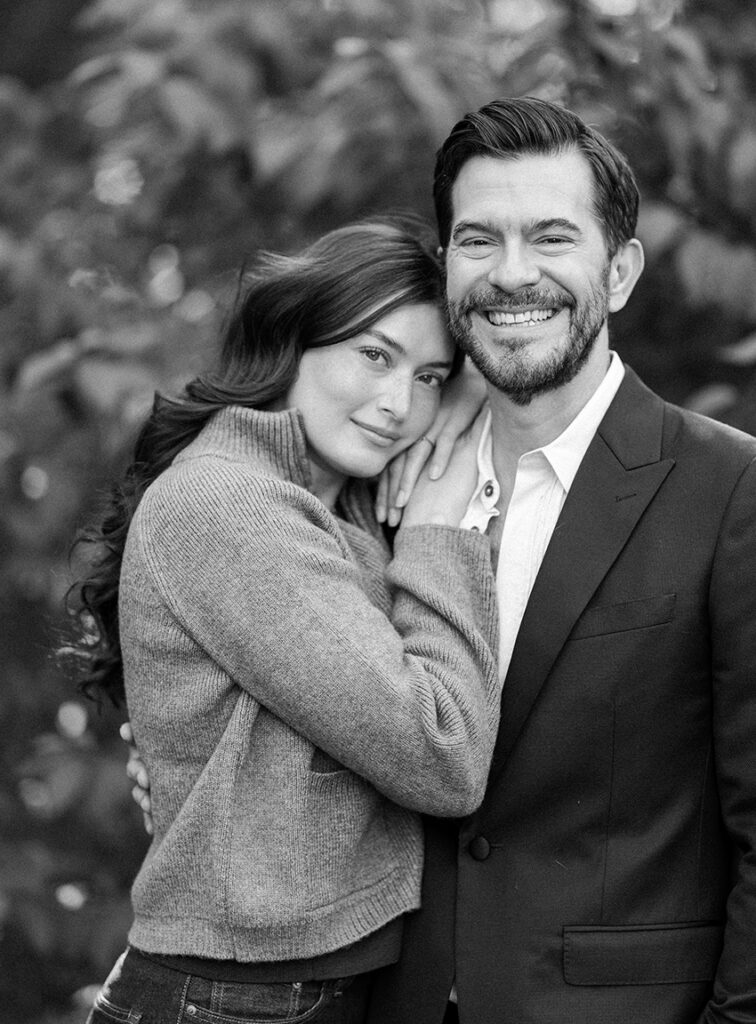
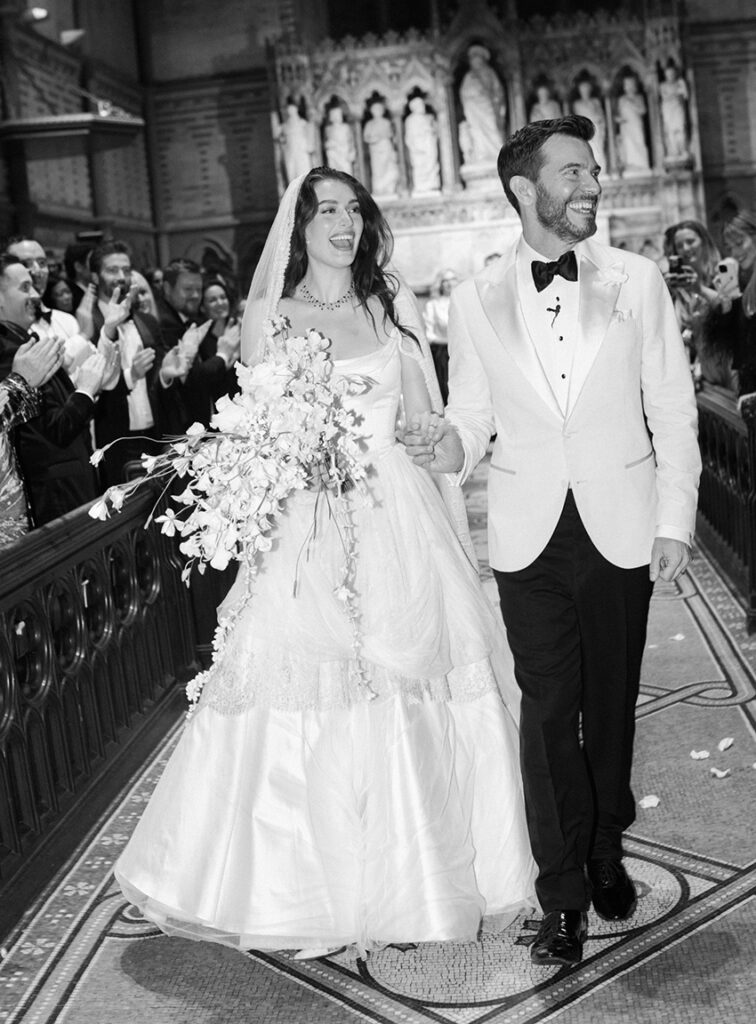
Peter and Jess were married on December 28, 2023, at the General Theological Seminary in Manhattan
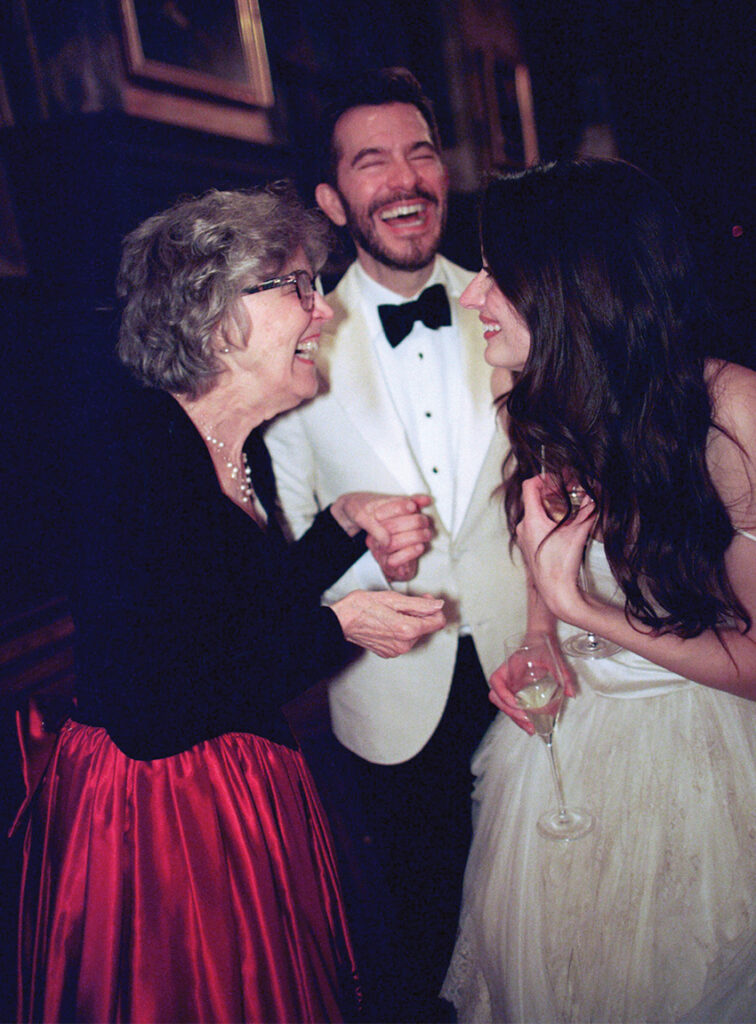
The couple with Peter’s mom, Mary Huyck
Laura once wrote a paper for freshman psychology that Jess would have found useful. It posed the question, “Is my brother insane?” The 12-page answer was yes—but in a good way. “The way Pete has always lived is fearless, stubborn, determined and totally committed to outlandish ideas,” she said later. “Pete’s still the most outrageous and the kindest person in the room.”
Soon enough, Jess discovered that second half. The two became friends, but at a distance, since she lived in New York and he in California. They met again at another far-flung destination—a friend’s yacht moored in Greece. “When he walked onto the boat, I remember turning and seeing him,” Jess said, “and we just locked in. The air was electric. Everyone kind of left the two of us to talk.
“Then the yacht dropped anchor, and we all jumped in the water, and we were just buzzing around, and Pete and I had this moment where we were floating there face-to-face. And I remember thinking, ‘I’m gonna kiss him.’ But I was really nervous. He was such a good male friend, and if this went badly, I was stuck on a boat with him in Greece. But I thought, ‘All right, I’m gonna count down from three.’ I went ‘Three, two…’
“And on two, he kissed me.”
ACT FIVE
Matt Remick is, against all odds, a touching creation. In the first episode—in which he leaves Martin Scorsese crying into his drink—the idea occurs to him that making baddish movies might be more lucrative than making goodish ones. And this pains him. “I got into all this because I love movies,” he confides to Patty Leigh, “but now I have this fear that my job is to ruin them.” How one wishes this sentiment were not true to life. But it turns out that a 20th-Century Studios exec once uttered this line almost verbatim to a young Rogen.
“There’s a joke we tell that if you get behind the scenes, you’re not surprised by how many bad movies come out, you’re surprised that any good ones come out,” Huyck said. “Because it’s this delicate, uncertain business, and if you could game it and codify it and figure it out, you would never have bombs, you would never have things that are terrible. So one of the themes of the show is that making something that people want to see is shockingly hard. And every step along the way is a step where it can be ruined. And that is why it’s funny to watch—because it’s always stressful.”
So how has Remick performed? At season’s end, we suspect that he might actually know what he’s doing—that he’ll stumble into putting out good movies—even if he gets no respect from the creatives. (Contrary to popular belief, “suits” do contribute excellent ideas, Huyck says. But also lousy ideas, which you still have to pretend are excellent as you quietly back-pocket them.) Will these movies save Continental Studios? We don’t know yet. In the season finale, we learn that Continental might get swallowed like Jonah—the whale being Amazon—and leave Remick and mates at sea.
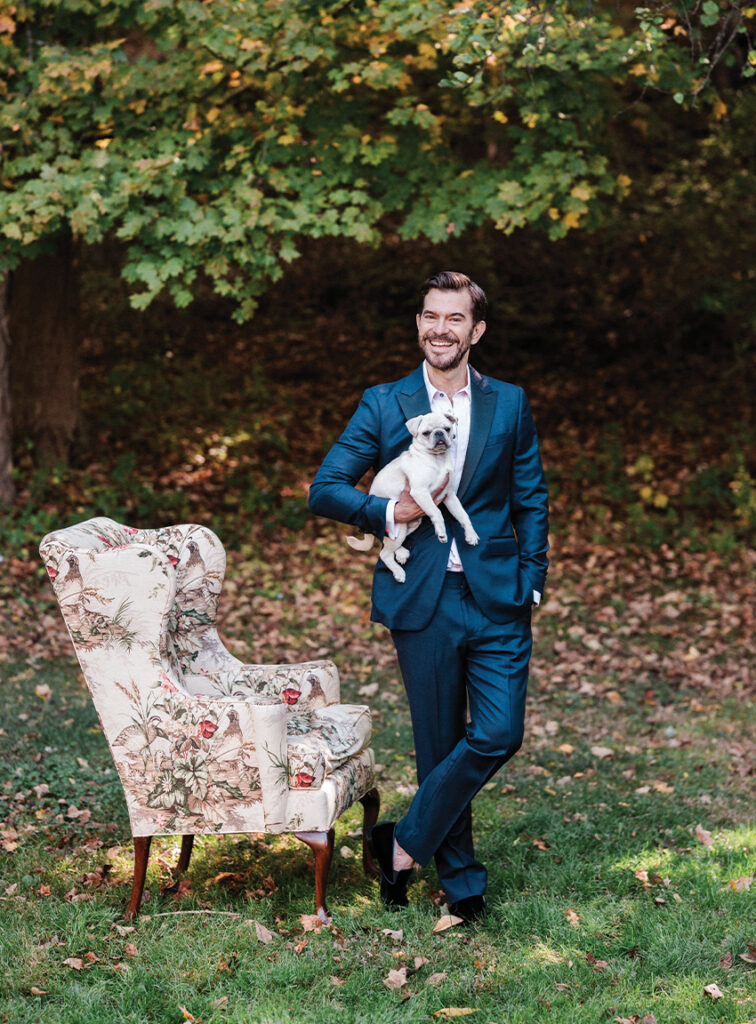
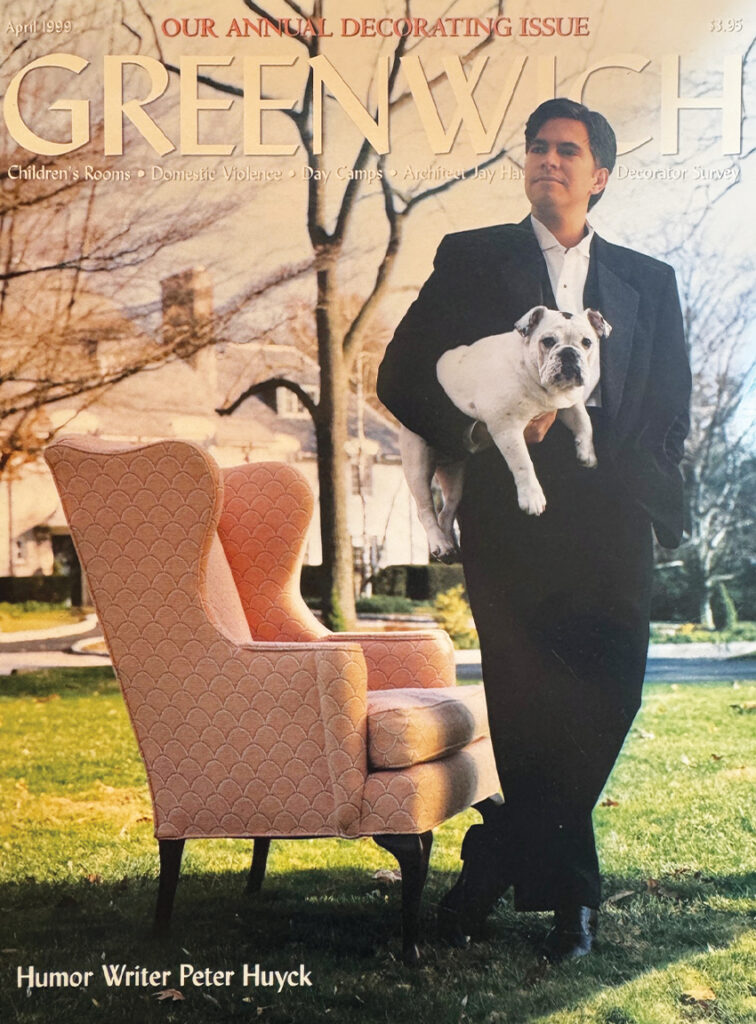
Peter recreates the cover shot from our story of 1999, which was titled “The Devil and Peter Huyck.”
Real-life Hollywood is living in a similar mood of foreboding. Box office sales are plummeting, and the streaming bubble has burst. A Great Contraction is throttling the Hollywood economy—productions are down, jobs have vanished—to the point where it resembles “a disaster movie,” according to the Wall Street Journal. President Trump noted in his own helpful way, “The Movie Industry in America is DYING a very fast death.”
Inside The Studio writers’ room, however, the mood is unreasonably bright. This room is an actual sanctum on the Warner Bros. lot, but it’s also a six-way text chain—Sarah Polley has joined the original five scribes—on which jokes are pitched at all hours. “If you don’t look at your phone for a bit—you might be at dinner—there’ll be like 260 missed messages, because the writers’ room is up and running. Someone has an idea, then everyone’s riffing, and we all enter that creative flow state.” This easy chemistry begins with Rogen and Goldberg: They’re Canadian. They’re nice. There’s nothing of the tyrant in them. They want to make comedy that rises to the level of art, but they want to have a good time doing it, and this may be their secret recipe: fun in the process, fun in the result. “Everyone who works for them wants to keep working for them forever,” said Huyck, “because they foster this creative Shangri-La.”
But what about those terrible storm clouds? Well, they have drifted into The Studio’s storyline, where they sit menacingly among the palm trees. Yet Huyck, ever buoyant, ever hopeful, believes it’s only a turbulent moment that The Studio is capturing. “However much of the news is grim and the business is contracting and changing, there are still people trying to finance movies and get them made. There are still people trying to make great TV shows. And you still have successes. So, it’s not done yet, but it is increasingly complicated.”
One review of The Studio, on the site Vulture, struck a gloomier note. It said, “The Studio laughs to keep from crying.” If the show is indeed writing Holly-wood’s death scene, may the dying go on and on.