

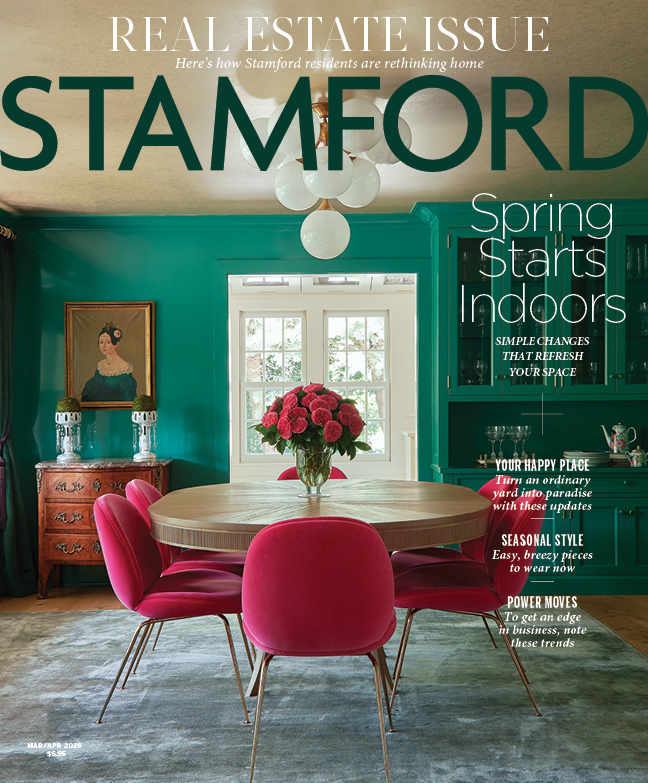

If you’re furnishing and decorating a 7,000-square-foot home virtually from scratch, it doesn’t hurt to have an interior designer in the family. Fortunately for the owner of this stunning five-year-old Sasco Hill Colonial, he’s related to Kat Burki, a top designer who happens to have an office just down the hill from him in Southport. And the best stroke of luck of all: Their tastes turned out to be totally in sync.
In fact, everything about this house involves the shining down of fortune. It started in 2001, when the owner (who requested anonymity for this story) was living in Wilton and finally felt ready to pursue his lifelong dream of living on the water. “I was driving through Sasco Hill one day and saw this property with an incredible view,” he recalls. “I got out of my car, walked around and envisioned exactly what it would be.” But fate had yet to smile, because the land wasn’t on the market and the owners weren’t quite ready to part with it. It took a year, but he finally persuaded them to sell it to him. “Today we’re not only good neighbors but also terrific friends,” he says.
As soon as he hired local architect Jack Franzen and Tallman Builders, his very next call was to Kat. With a visual-arts background and a short-lived foray into law, she was just getting her design business off the ground and was thrilled by the challenge to do a house in its entirety. This though was not just any house, but one that would be decorated as it was being built.
“It was a dream situation,” says Kat. “Because we were working from scratch, we could get everything right the first time — the lighting and switches, the moldings and drapery, everything.” Because she sat in on the weekly meetings with the owner, architect and builder, potential problems were addressed before they occurred, saving time and not a little bit of money on change orders.
Kat recalls her first meeting with the owner — at the site as the concrete was being poured. “It was so exciting,” she says. “We discussed his vision of the house, what he wanted, didn’t want, and what he planned to bring from his previous home.”
As he puts it, “I was going for something very traditional, like a sea captain’s house. I liked the idea of a neo-Colonial with classic white shingles and black shutters.”
The other thing that was essential to him was maximizing the view, the raison d’être of the home, in a sense. “I wanted very few interior walls and knew that we could use windows and French doors to let in as much light as possible,” he says.
For the next twenty-six months he enjoyed a rental home near the water while the team kept him up-to-date on the details of the project. Once the overall style and look were determined — classic Georgian architecture, mostly English antiques and custom-built furniture with some Oriental touches, except for a decidedly French country kitchen — it was time to hammer out specifics.
“For me, it always begins with a color scheme,” says Kat. “I have to start that way. I knew we were trying to make this feel old, and I knew the different rooms would be different colors.” From there she selected fabrics and then created models of the rooms, moving furniture around until she got the exact look they both wanted.
It worked. At one of the first dinner parties he hosted, a guest asked what era the house was from.
For the most part, Kat and her client saw eye-to-eye. They both brought pages they had torn from magazines to their regular meetings. Three times they brought each other the exact same page, and these pages ultimately inspired the family room, the office and the master bedroom. When choosing fabrics, Kat sometimes got so excited that she took digital pictures and e-mailed them to the owner for immediate feedback (and gratification). On weekends, the two would go shopping together for materials, like stone and marble, and antiques, usually gravitating toward the same pieces.
But there were a few things that Kat had to talk her client into. “In the living room, I really wanted to paint a green strip in the molding, but he wasn’t seeing it,” she says. “And for that same room, I had found these two little green velvet French slipper chairs. I loved them, but he didn’t. I said, ‘Please trust me on these two things.’ He did and wound up loving them both. That’s when we turned the ‘trust corner.’ ”
This is typical on every job, Kat says. There usually comes one moment when the client doesn’t like a suggestion and she has to ask — sometimes actually beg — him or her to take a leap of faith.
The reason, she explains, is that clients are not seeing the big picture the way she is. Until it all comes together, which can be months, her ideas are out of context and might not make sense.
Little by little, over the project’s two-plus years, all the pieces became the whole, and the owner couldn’t be happier with the results. “The best part is that Kat not only created what I wanted, but she also exceeded my expectations. I could not have been able to envision the color schemes or fabrics that she came up with.”
In fact, the whole process was enlightening. “Working so closely with the builder and architect and Kat gave me an intimate understanding of the bones of the house and the details. It was rewarding to be in on every decision, from furniture to fabric to hardware. And shopping with Kat was fun; she made the whole thing stress-free.”
Undertaking such an enormous venture was a first for the homeowner and the designer. Both feel it was completely successful. “Now I would have to say I’m an educated homeowner,” he says. “And being able to look out the windows every day and see an ever-changing piece of art is a tremendous feeling. It’s very gratifying.”
Inspired? This spring, look for Kat’s collection of high-quality classic furniture pieces and accessories — from French birdcage chandeliers to English cashmere throws.