







Clay Singer as the Phantom in Masquerade.
In 2013, I sat in the audience at Cynthia Gibb’s Vocal Studio recital in Westport and watched a senior named Clay Singer sing the closing song. He sang “Something’s Coming” from West Side Story with a voice that wraps around your insides and lifts your heart a couple inches in your chest. Imagine that voice, 13 years later, singing as the Phantom in the new immersive musical Masquerade in New York, directed by creative genius Diane Paulus. What I can tell you is that Clay was right: Something was coming.
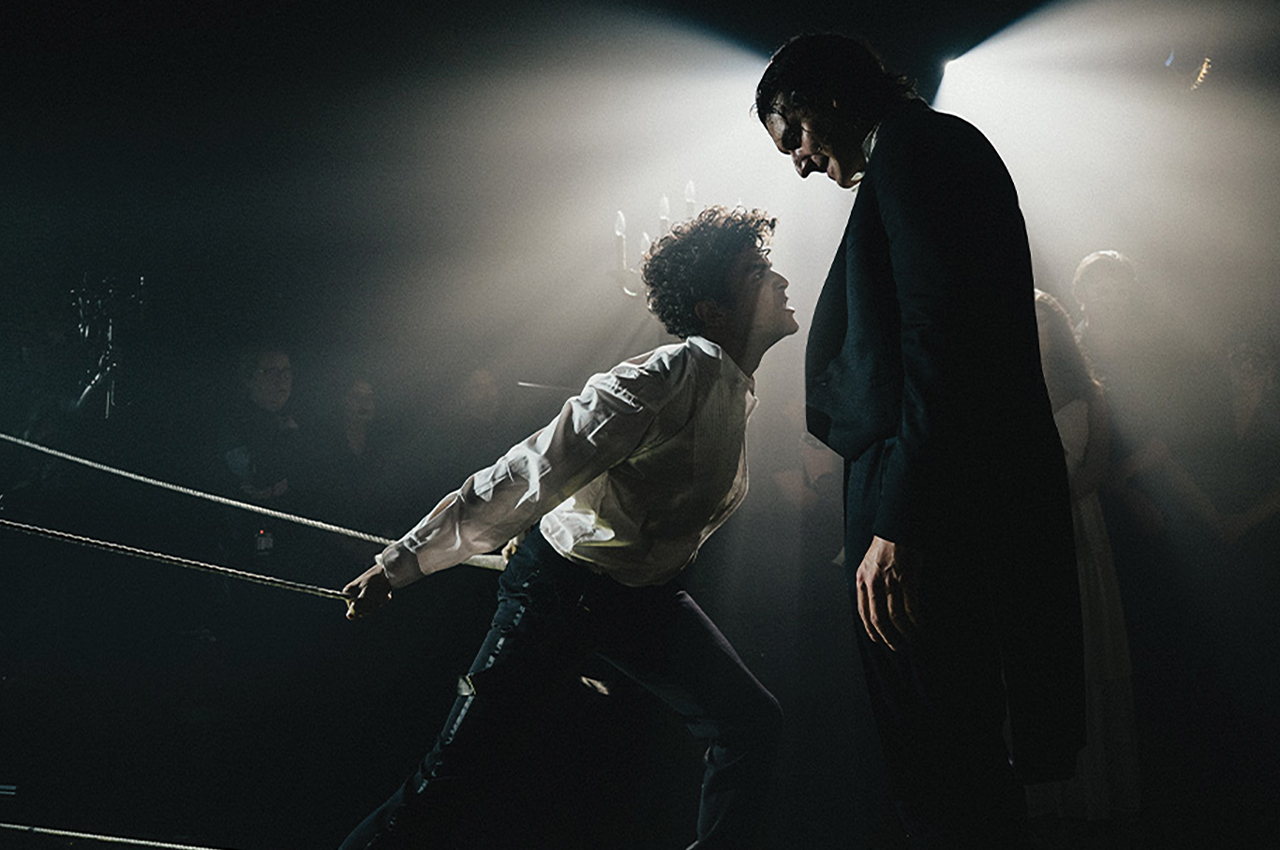
Francisco Javier Gonzalez and Clay Singer
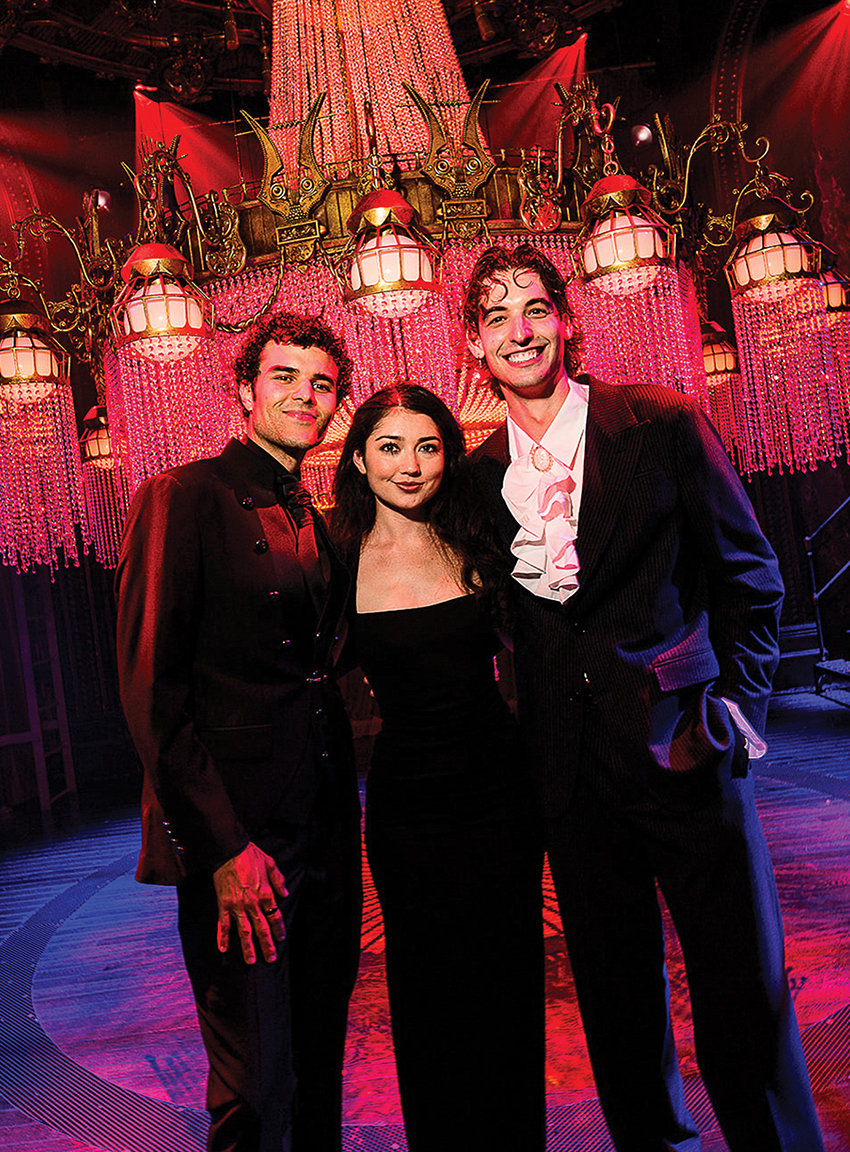
Clay with cast mates Francisco Javier Gonzalez and Riley Noland.
Not only is Clay the youngest of the six Broadway actors playing the Phantom in this production, he is the youngest to ever play the role in the U.S. His age (30) serves him well in a show that requires sprinting up and down seven floors in eight shows a week. It also serves the chemistry of the love story. Clay layers sinister, sexy and vulnerable onto his Phantom with exquisite mastery. No doubt each Phantom, including Hugh Panaro, who performed the role 2,000+ times on Broadway, seduces the intimate audience at Masquerade.
“Intimate” is the operative word here. Six shows happen each night (plus six more on weekend afternoons), taking each audience of 60 on a two-hour journey through the Paris Opera House—brought to brilliant life in a huge building on 57th Street (formerly Lee’s Art Shop). Guests don cocktail attire and festive masks, check their coats, pick up a glass of champagne, and essentially become part of the show as they are ushered through a maze of spaces, with a room-size chandelier falling to the floor, a moving gondola, a scintillating bedroom scene and a fresh take on the Phantom of the Opera. An actor’s hand on your back, one spilling popcorn in your mouth while a man breathes fire a few feet away, the phantom’s face so close you can see his lip quiver—these moments are what make Masquerade so powerful. It will ruin you for a show viewed from afar on a stage.
THE MAKING OF A PHANTOM: FOLLOW THE FEAR
Clay Singer was at The MUNY performing as Perchik in Fiddler on the Roof when he heard rumors of auditions going out for this inventive show. He pushed his reps to get him in and submitted an audition tape for Raoul. “A month later, I got a callback to do another tape for Raoul and to tape for Phantom,” says Clay. “I thought, There’s no way that will ever happen. I can’t sing this material. Maelyn [Jarmon], my partner, was like ‘No, you can do this.’ She’s an unbelievable vocalist. She won The Voice.” The cheerleading worked. “The audition process was a beast,” says Clay. “It spanned six months.”
Clay learned a valuable lesson. “My new mantra is: Fear is good. It’s a green light that you should follow fear and just jump into it,” he says. “Honestly, I could not sing the material. I was singing it at my apartment every single night and throwing anything I could at the wall. The work does pay off.”
After two exhausting weeks in this physical and vocal marathon of a show, Clay thought, “I can’t do this.” But the body and voice are muscles; they adjusted. “I’m not sure people realize: actors are athletes,” says Clay. He was also apprehensive about acting so close to the audience but now leans into it: “If I look at an audience member and they look away quickly, I can take their response and use it as the hate the Phantom has received his entire life. I use it to fuel my own self-loathing. It’s like having a whole new scene partner.”
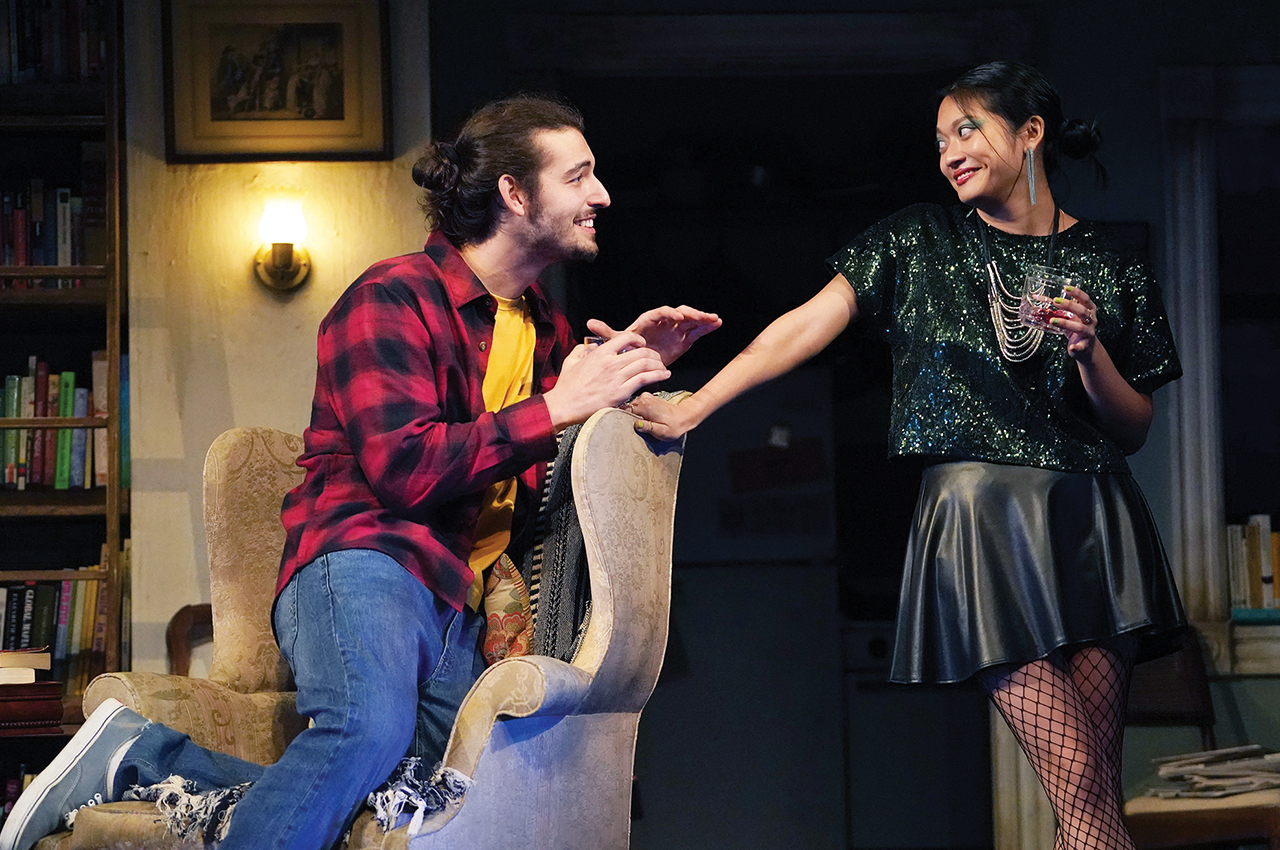
Clay Singer and Phoebe Holden in 4000 Miles at Westport Country Playhouse.
WESTPORT’S ROLE: LOCAL TEACHERS & INSPIRATION
The foundation of Clay’s vocal technique goes back to Cynthia Gibb, famed actor herself and founder of Triple Threat Academy. “She was my voice teacher in Westport,” says Clay. “I did Rent one summer and destroyed my voice. She gave me such an incredible foundation for how to actually build on technique and get my voice back to a place where I was able to sing and sing more classical stuff that year. She really, really helped me get to the colleges I got into and feel more comfortable and confident in my voice.” Clay landed at Carnegie Mellon, a tippy-top-tier musical theater program, in one of 12 spots.
Gibb recalls Clay’s Rent vocal wreckage before ninth grade. “We got it back in time for his fall musical audition two weeks later,” she says. “We worked together weekly over the next fours years. I heard his potential at 14, but it was after his voice matured and we added technique that you could hear his beautiful tone that stops people in their tracks. When he played the lead in Oklahoma at Staples, someone in the audience thought the school had hired a professional from the city!”
Going way back, Clay remembers belting “Ave Maria” at age four, mimicking his older sister Charlotte. “I started performing with Jill Jaysen,” says Clay. “She had a little theater in a church in Westport, so I got to do shows with her.” (Jaysen now teaches at Gibb’s school.)
In third grade Clay was handed a flyer for Oliver. Staples was holding auditions for orphans. “I showed my mom and said, ‘I don’t really want to do it,’” recalls Clay. “She said, ‘Clay, you’re going to do it.’” He was cast in the high school show and says, “I was hooked.” (Bravo, Robin Singer!)
At Bedford Middle School, Clay enjoyed directors Kevin Slater and Karen McCormick. “Kevin was a huge part of developing my love for theater,” says Clay, “and obviously David Roth and Kerry [Long] at Staples.” As a Staples Player, Clay gave up his football pastime and poured himself into lead roles. “Clay was the best of the best,” raves Long, “and I’m not only talking about his performances onstage. Off-stage, he was exactly the type of guy you wanted to work with—kind, considerate, patient, hard working and just all around loveable.” Clay says, “We got to perform on a stage bigger than most regional houses, with higher budgets than most regional houses, with full orchestras. And we were performing with our best friends. Those are some of the greatest memories I’ll ever have performing.”
The Phantom whose performance most influenced Clay happened to be Westporter Kevin Gray, the youngest to perform the role on Broadway. “I watched every single bootleg of the show,” says Clay, “and he is the person who affected me the most. He was heartbreaking.”
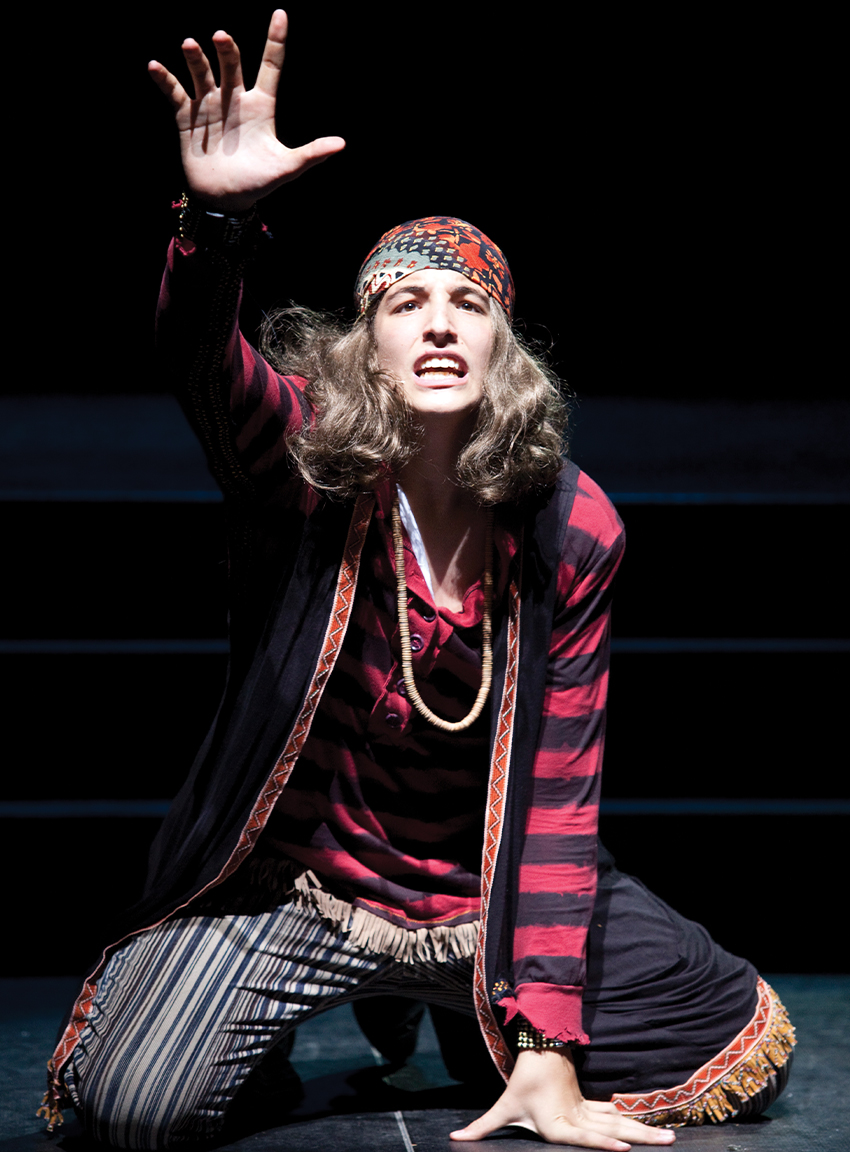
Clay as Judas in Jesus Christ Superstar at Staples High School.
HIGHS, LOWS & LATE FAME
Clay has racked up wins—The Band’s Visit Broadway tour, three plays at Westport Country Playhouse (most recently, 4000 Miles), The Last Five Years (where he met his partner), Romeo and Juliet (with his idol Terrence Mann, and Paulus directing)—but his resume masks the tough times. Covid shut down The Band’s Visit after only three performances. Clay ultimately spent 10 months in the tour, but being on the road isn’t easy. “I needed to root myself,” he says. “I got an an apartment in Brooklyn. I was auditioning a lot, but I didn’t get a single job in 18 months.” He picked up work as an event planner and line cook to pay the rent.
“I was really unhappy,” Clay says. “I was drinking and smoking a lot of weed. It was a really dark time.” Something had to change. He got sober in 2023 and quit his event-planning job, “which was sucking the soul out of me,” he says. “The day I left that job, I went to an audition and booked the job in the room.”
Clay has worked steadily ever since, including in the upcoming film Late Fame with Willem Dafoe and Greta Lee. “It was low-budget so we didn’t have trailers. We would all hang out in the same room,” explains Clay. “It was a group of five guys and Willem. He would always have a Sumo orange at lunch. He would peel it and pass it around the circle, and we would talk and laugh and tell stories. He had no ego whatsoever. He’s still incredibly curious. Every night I got home from doing that job, I pinched myself.”
After his unleashing of heartrending emotion as the Phantom, Clay and I chatted at the Masquerade bar. He had the same eager, ego-less energy he had as a teen. “This industry is crazy. You’re not well in the head if you think you should do this,” he says, with a chuckle. “But it’s a beautiful thing to be able to perform and give people a catharsis that they don’t get in their day-to-day lives. I’ve had people say about Phantom, ‘This show saved my life.’”
Masquerade runs through July 5: masqueradenyc.com
(Clay performs in the 2 p.m. and 8 p.m. shows.)