







Backyards across Stamford and Fairfield County are being reimagined—not as leftover green space, but as an essential living space. “Yards matter,” says Heather O’Neill, owner of Second Nature Landscape Design in Norwalk. “People want their property to look beautiful and their houses to be the place to hang out.” As homeowners spend more time outdoors entertaining, relaxing, exercising and even growing their own food, local landscape designers are responding with ideas that blend beauty, function and a sense of escape. We spoke with area professionals who are shaping these outdoor spaces to see what’s defining yard design right now—and what homeowners are asking for this season.
The Resort-Style Pool
One backyard element that continues to grow in popularity is the in-ground swimming pool.
“During and right after COVID, a lot of real estate agents were asking if there was a pool on the property and, if not, could one be installed,” says Mariana Demoura, co-owner of Oceanview Pool and Patio in Southport. “That feature was particularly important to home buyers moving from the city. If it’s hot out, people want to be in the water at home rather than go to a country club or the beach.”
Local landscape architects agree that a well-designed, resort-style swimming pool elevates a yard’s appeal and perceived value. And certain features are always attractive to owners. They include built-in seating, sunning edges and shelves, shallow ends for children, fountains, hot tubs, vanishing edges that connect water and sky and, for homes with a view of Long Island Sound, outer-edge glass walls.
These structural features are in demand today, but the water in the pool is also a powerful design element, with visual and audible virtues. The color in the pool, for instance, immediately draws the eye and soothes the soul. Other popular features near the pool include fountains and waterfalls, as the sound of moving water can often calm the senses while simultaneously masking invasive noise from the street.
“When remote work became popular, people saw their houses not just as a place to sleep but truly as a place to live,” says Nick Ackerman, a designer at Glengate, the landscape, pool and lifestyle company in Wilton. “Amenities people found while travelling or on vacation started to be created on their own property.”
At the same time, says Ackerman, thecompany noted “a strong shift away fromoverly formal, high-maintenance landscapes. More people wanted environments that felt natural and livable.” Today, that’s translated to preferences for organic shapes over linear forms, and natural colors and native plantings around pool areas. These elements can do more than just create an aesthetically pleasing environment.
For a one-acre property close to a busy road and traffic in Ridgefield, Glengate introduced several water features to help drown out some of the distracting sound and create a more calming environment. In addition, a stand-alone spa close to the house spills into a new swimming pool with a vanishing edge that, in turn, spills into a lower basin. A valving system with multiple levels controls the flow—and sound—of water emptying from the central pool to the basin below the vanishing edge, helping drown out the noise from the street.
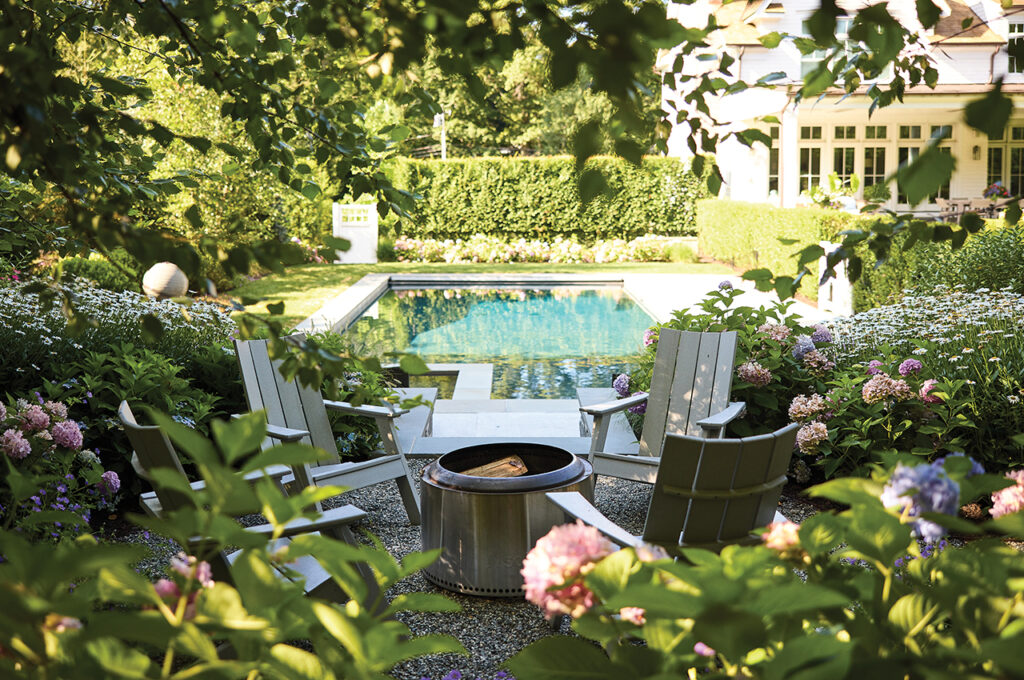
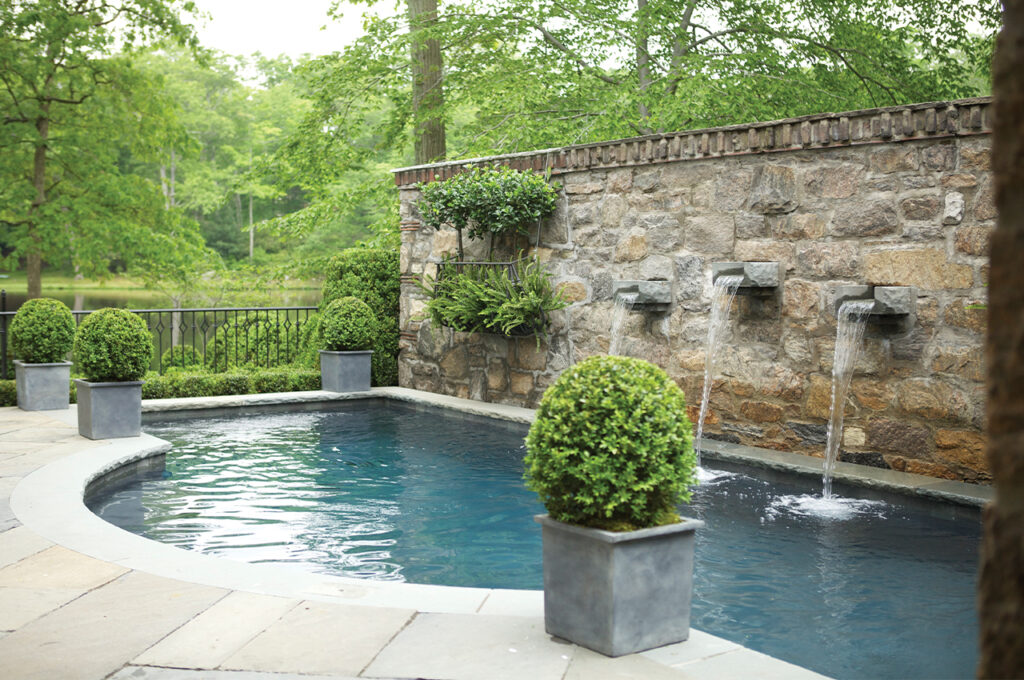
Stonework and water features elevate a pool.
“That’s where you’re getting the consistent calming sound of water flowing,” says Ackerman. “It’s not just the sound of splashing in the pool but something that has a little rhythm. Just as we find peace in music, we find peace in the rhythm of water.”
Meanwhile, the stonework that surrounds the pool—and other outdoor areas such as the dining space and firepit—continues to evolve. Plain slabs of rock are giving way to stone masonry threaded with ornamental grasses and gravel. There’s also a wider range of materials in use, from limestone, bluestone and granite to classic coverings like brick pavers, porcelain tiles, stamped concrete and recycled rubber pavers. As a result, today’s patio is more than an extension of a house’s indoor flooring. It’s a singular design element.
GARDENS BIG AND SMALL
One of the most colorful trends in landscaping challenges the notion that you need serious acreage to create eye-catching design. You don’t. What you do need are pots, containers and a talent for packing them to overflowing with as many plants and as much color and contrast as possible.
“A container with flowers and herbs and some kind of shrub softens the whole patio,” says O’Neill. “To have all that texture and color is like a garden within itself, and if you have multiple pots, you get multiple landscapes. And if you don’t like what you’ve done? Rip it out and start over.”
O’Neill uses stone or composite containers to hold mixtures of practically anything that grows. She selects plantings that complement the style of the house and the size of the property. It’s also important to scale containers to a space. Small pots, for instance, should not be placed at the entrance to the house, around large dining and seating areas, or against the backdrop of ample acreage, because they are likely to get swallowed up.
Micro-gardens in containers can flourish all season, although some designers will change them out. Regular watering is critical for maintaining them. Most of O’Neill’s clients have sprinkler systems that drip water directly into the pots, so they don’t have to water by hand. One of the benefits of gardening on this miniature scale, says O’Neill, is that it allows for experimentation without a big investment in time and money. And the results can be amazing.
Last December, Sandy Lindh received what she calls an unusual request. “It was for plantings in pots, of vegetables mixed with edible flowers,” says the owner of English Gardens & Design in Greenwich. Soon after, other requests for the same type of containers came in. Some people wanted specific vegetables; mini-tomatoes, eggplants, snow peas and sweet peas were popular requests.
So, Lindh set off on a hunt for large, handsome pots and planters. She found some in a shop outside of Paris and others closer to home, at Pennoyer Newman, an online supplier of high-end garden containers made in Santa Monica, California. The containers are stone resin replicas cast from original planters from the gardens of great estates here and abroad.
Now, Lindh and other designers are mixing flowering plants, shrubs, herbs and edibles all together in a single container. They position them around outdoor dining and seating areas. In addition, they plant grape vines and runner beans to hang over pergolas, and they grow espalier apples and other fruit vertically up outer walls. “People are asking for this sort of ornamental but veggie all-purpose look,” Lindh says. “We like to feel we’re in this beautiful, all-encompassing, edible garden room.”
Meanwhile, Homefront Farmers in Redding continues to see demand for the full-size vegetable gardens it designs and installs in raised beds protected by fencing. The company says clients like the idea of practicing yoga and meditation, or simply enjoying morning coffee, near the flutter of winged things pollinating and gathering nectar in the gardens. But the real appeal is the opportunity to walk out the back door and gather greens for dinner and fresh-cut flowers for the table.
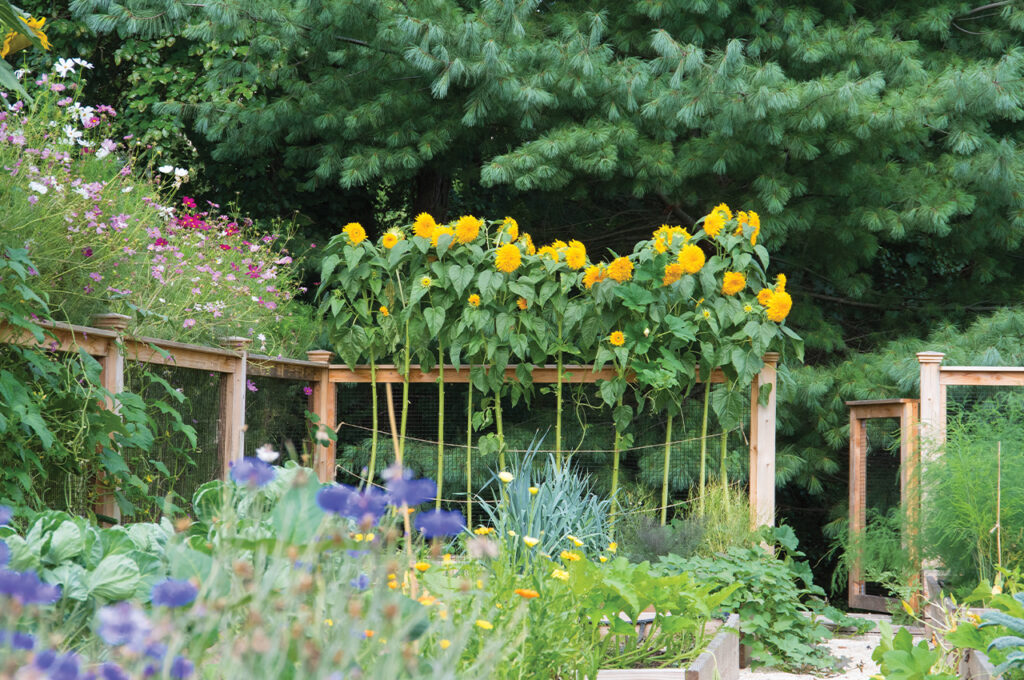
A raised garden bed protected by fencing was installed by Homefront Farmers.
“Instead of having to run to the grocery store, burn gas and waste time sitting in traffic, you can pop out to your garden and pick a delicious, fresh salad for yourself and your family,” says Miranda Gould, director of operations. Customers’ most common requests for this season, says Gould, are heirloom tomatoes, lettuces, cucumbers and peppers, plus dahlias and muted zinnias for the flower beds.
PUTT FROM HOME
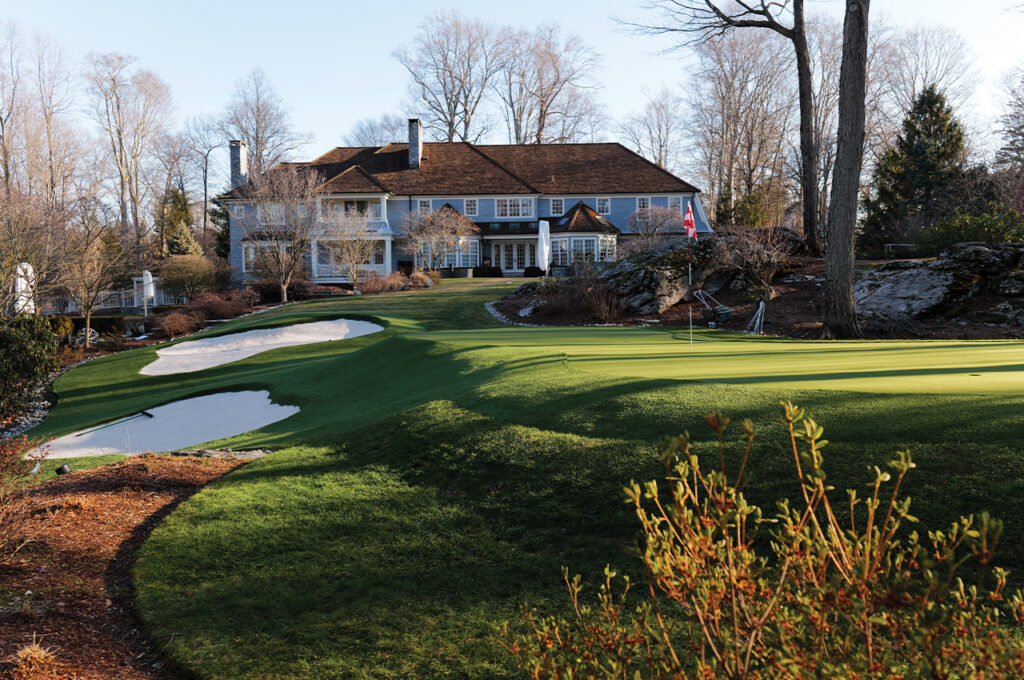
The demand for at-home putting greens is on the rise.
One of the fallouts from the COVID-19 pandemic, at least in parts of Fairfield County, was the temporary closure of public and private country clubs and golf courses. That was a tough time for some residents, as they had to work through the mood swings associated with putting-green withdrawal. But as a result, the demand for at-home artificial putting greens increased. And it continues to do so.
“Along with the pool guys, we were busy during COVID,” says Neil Robertson, founder of Prolinks Putting Greens in Wilton. The company has been designing and installing custom home putting greens since the early 1990s. “Recently, there’s been an uptick in business, and our projects have gotten more elaborate, with more bells and whistles and multiple traps. We’re also getting requests to use the same sand as clients have at their clubs.”
Prolinks uses artificial nylon grass on its greens and synthetic fringe collars around the edges. For the traps or bunkers, it relies on a third-generation company that supplies a custom mix of natural sand to all the golf courses in Fairfield and Westchester counties. The main benefits of artificial turf on a putting green include year-round consistency of a smooth, predictable surface and low maintenance. You don’t have to water, fertilize or mow it. “All putting, no cutting,” says Robertson.
For Robertson, the process of building the green starts with walking the property with a client. He’ll take note of preferences, the lay of the land (including elevations), green size relative to the size of the house and ideal positions for the traps. Robertson then paints an outline of the green on the location. After removing all the organic material from the footprint, he installs a compacted aggregate base of reclaimed material—crushed rocks, asphalt and brick—until reaching the desired contours.
“The quality of artificial turf mimics a real putting green as far as the roll and speed of the ball,” he says. “So it’s comparable to a good country club.”
Taken together, these trends point to a simple idea: Today’s landscapes are designed to be lived in. Whether it’s a pool that turns a backyard into a summer destination, a container garden that brings color and fresh food within arm’s reach, or a putting green that keeps a favorite pastime close to home, residents are investing in outdoor spaces that reflect how they spend their time. It’s proof that some of the most meaningful improvements to a home don’t always happen indoors.