







CARTOONS BY MORT WALKER // PORTRAIT BY STAN DRAKE
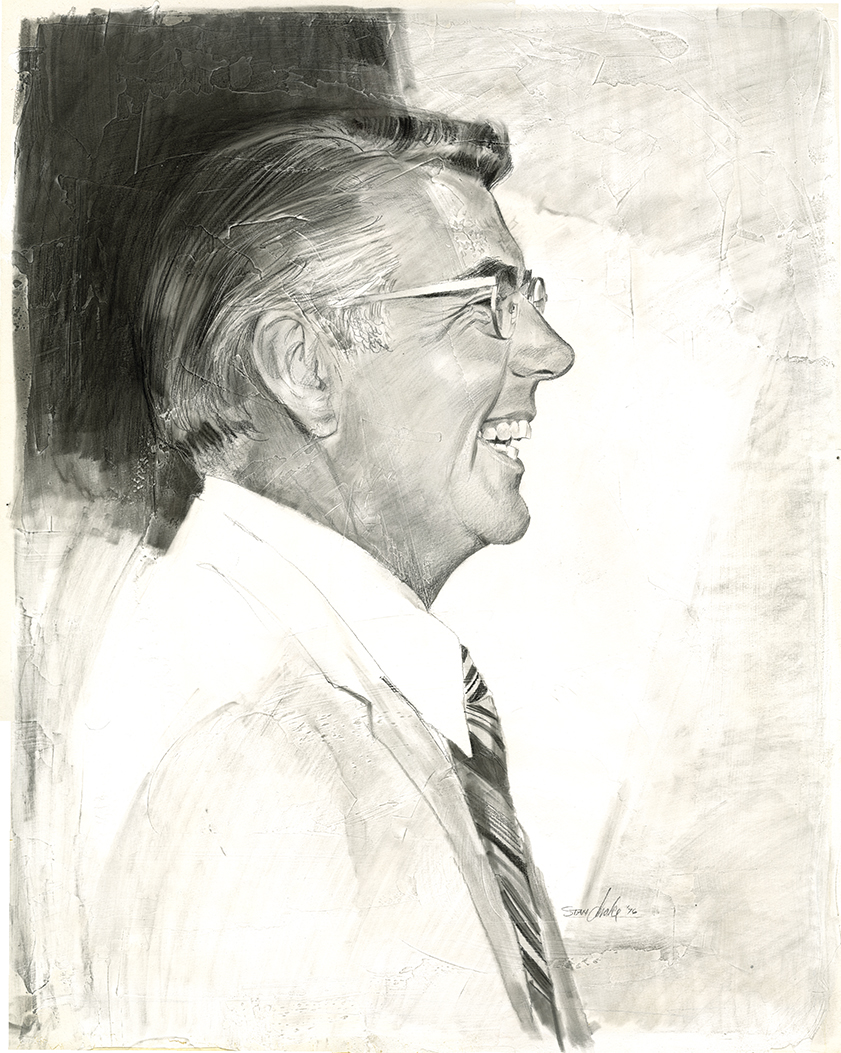
MY FATHER WAS A CARTOONIST.
In June of 1956 he rolled into the Belle Haven driveway of Mort Walker, creator of the popular comic strip Beetle Bailey.
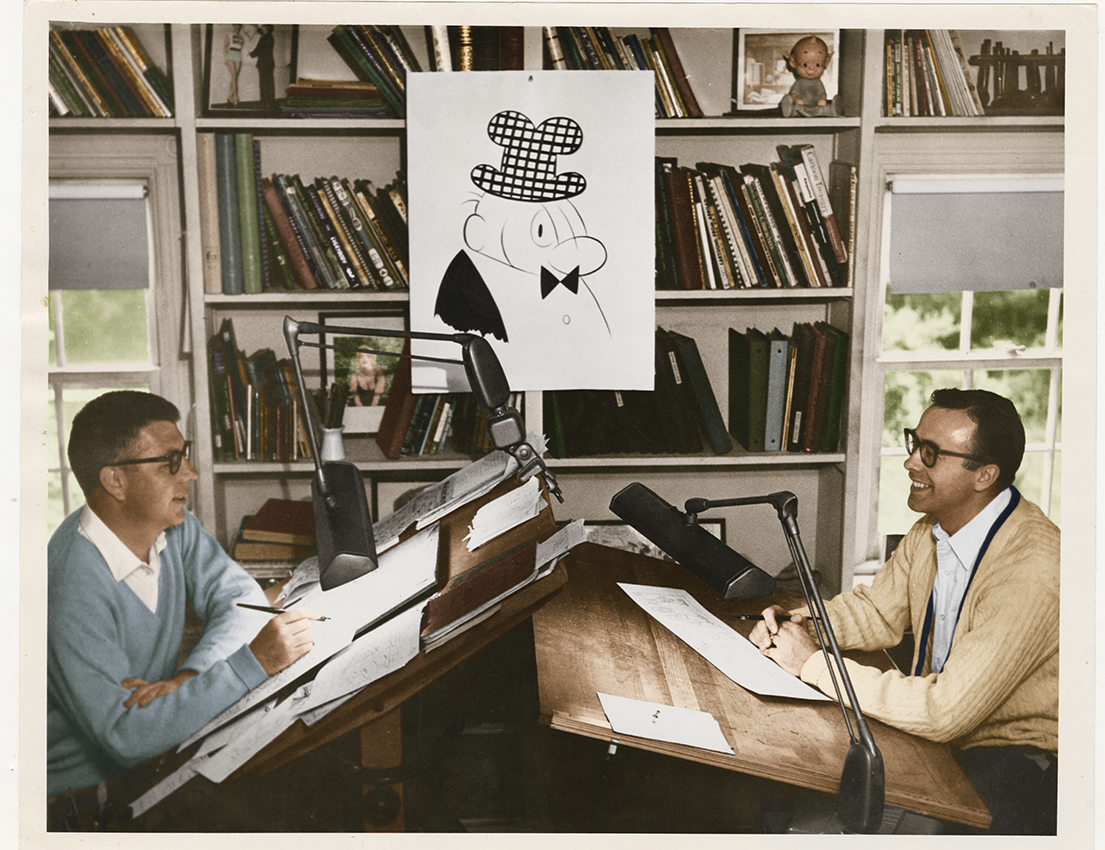
I picture Dad, a self-assured 26, fresh from the Air Force and Arizona State, dressed in chinos and a button-down short sleeve, his battered portfolio wedged under one arm. Mort, 33, came out to greet him. They shook hands in the middle of a flagstone path: not quite mirror images of each other, but, with their trim physiques, tidy haircuts and round cartoonists’ glasses, of a definite type. Then they repaired to the kitchen, where Dad untied the portfolio. Mort flipped through the pages for three or four minutes and said, “How soon can you start?”
“Right now,” my father said. Dad worked with Mort on Beetle Bailey and other comic strips for the next 60 years, until his death in 2016. Walker himself left the terrestrial drawing board in 2018, at age 94, but Beetle carries on ably via his sons Greg, Brian and Neal, who this year are celebrating the strip’s 75th anniversary.
Brian Walker also happens to be an eminent comics historian and curator. To mark the anniversary, he has written a retrospective anthology titled Mort Walker’s Beetle Bailey: 75 Years of Smiles. As I leafed through its sumptuously illustrated pages, my 1960s boyhood came floating back to me. On lucky days, Dad would drive us down to Mort’s converted-barn studio on Mayo Avenue. The studio was a mildly insane children’s paradise: comic art covering the walls, comic-strip carpeting on the floor, comic books and pop-eyed figurines bursting from the shelves. Soon there would be a poster of a naked Miss Buxley, the Beetle Bailey sexpot, reclining like Gulliver as the Lilliputian soldiers of Camp Swampy traipse across her curvilinear physique with an assortment of sporting goods and work tools.
One detail, though, was all business: a wall-map dotted with red pushpins to indicate the towns and cities where Beetle Bailey appeared. There were coastal pile-ups, Midwestern blotches and stray berries sprouting in desert outposts, all adding up to a single fact: Mort was the hottest cartoonist in the world, alongside Peanuts creator Charles M. Schulz. In 1965 Beetle Bailey crossed the 1,000-newspaper threshold—only the second comic strip ever to do so, after the much older Blondie. (Peanuts then had 770 papers, but its cultural cachet was already second to none. That April Time put the Peanuts gang on its cover, and that December CBS debuted A Charlie Brown Christmas—an instant classic.)
Beetle and Peanuts have always been curiously intertwined. Both debuted in 1950—28 days apart—with such meager success that their survival was in doubt. By decade’s end, each was world famous. Comics historians credit them jointly with reviving the humor strip (which had been the lifeblood of the early funny pages, before adventure strips like Tarzan, The Phantom and Prince Valiant came of age) and endowing it with a new subtlety and sophistication.
But the two strips were markedly different in tone, Peanuts the yin and Beetle the yang of the comics. Beetle often topped reader polls—it was arguably funnier than Peanuts—but Peanuts was more emotionally affecting and certainly more marketable: its cute, eccentric children and inspired fool of a dog would eventually translate into an empire worth billions. Peanuts also possessed a poetic melancholy that turns out to have been autobiographical. Charlie Brown, the hopeless yearner at the heart of the strip, the dreamer whose every dream is dashed, is nothing less than a self-portrait of the cartoonist as a young man—lonely, awkward, a failure.
Mort Walker, on the other hand, had been a popular young man whose gifts were amply recognized. The caption below his high school yearbook photo would have made Charlie Brown groan with envy and disgust: “Absolutely TOP-NOTCH in everything.” Beetle, though less overtly autobiographical, reflects a happy-go-lucky, cheerfully rebellious, somewhat naughty author who seeks free will in a world that would fence him in. “Nobody likes to be told what to do—that’s the essence of Beetle Bailey, right?” Brian Walker observes. Mort himself once said of his characters, “They resist in order to exist.”
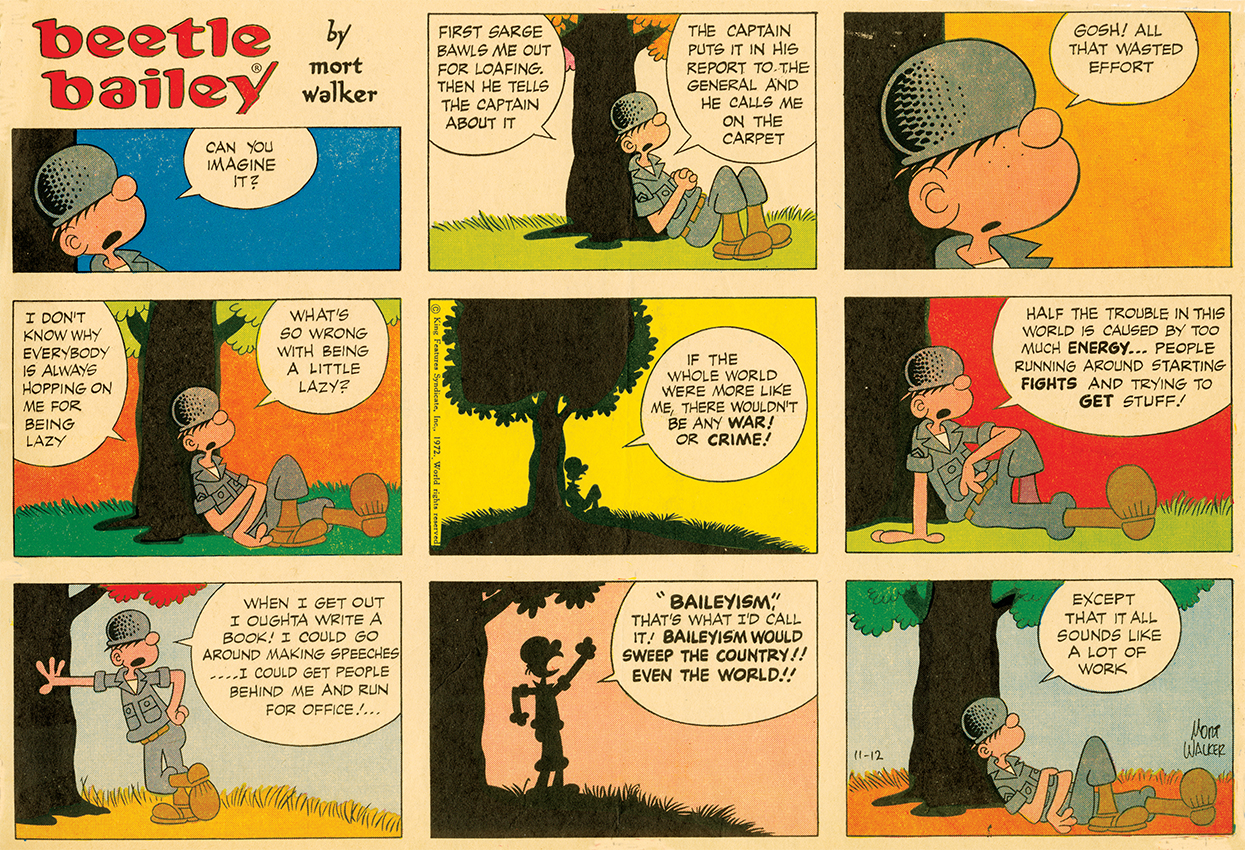
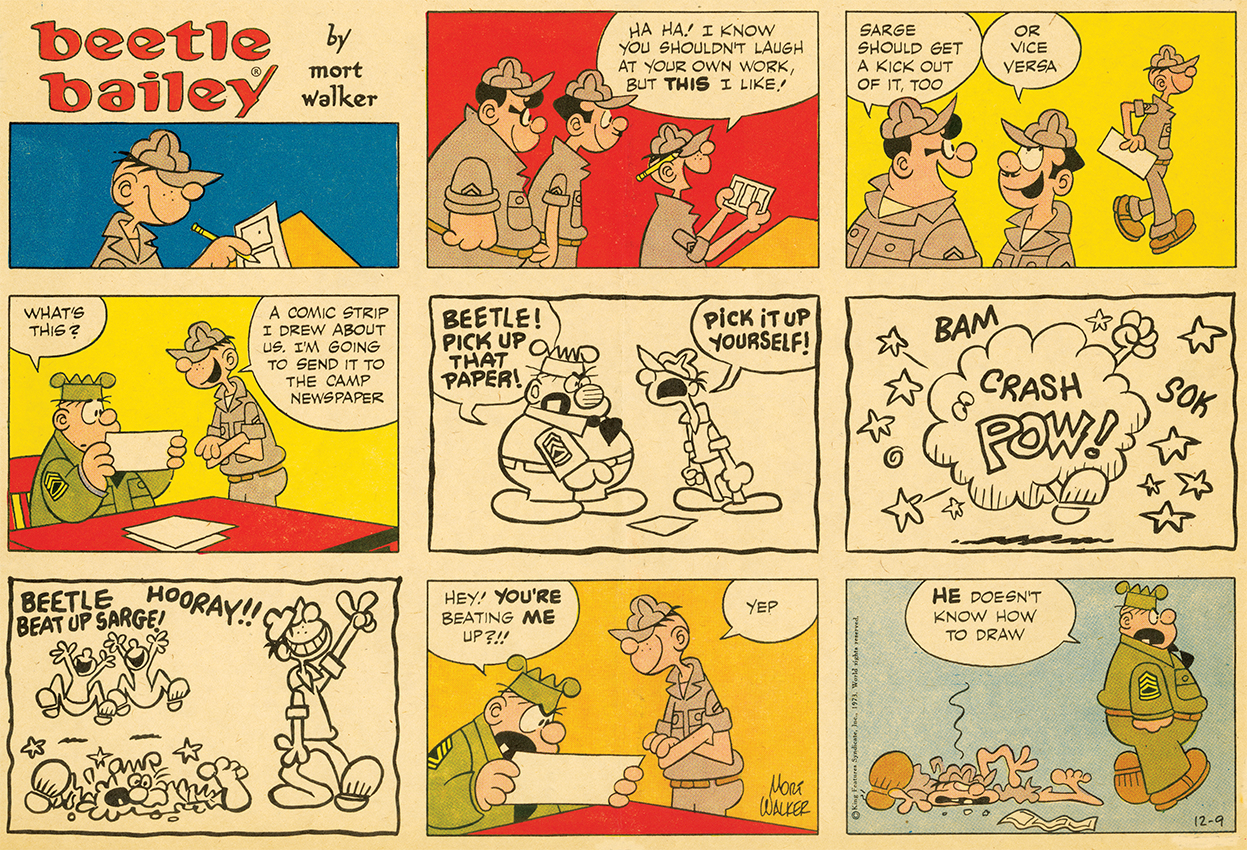
Beetle is the resister-in-chief, an Everyman outwitting “the system.” But he works so hard to avoid work that doing the work in the first place would have been easier. Not to mention less hazardous: Many is the day when Sarge leaves Beetle in a crumple of splayed limbs and broken teeth. The one character who is eager to do things right, the sweetly naive Zero, is incapable of it. Out on bivouac under a full moon, Beetle says to Sarge, “You sent Zero out to scout the perimeter?” “Yeah,” Sarge says. “If he sees the enemy, I told him to say ‘who’ like an owl.” Then, from distant trees, we hear Zero give the signal: “Who like an owl!”
HALFTRACK, BUXLEY AND CONTROVERSY
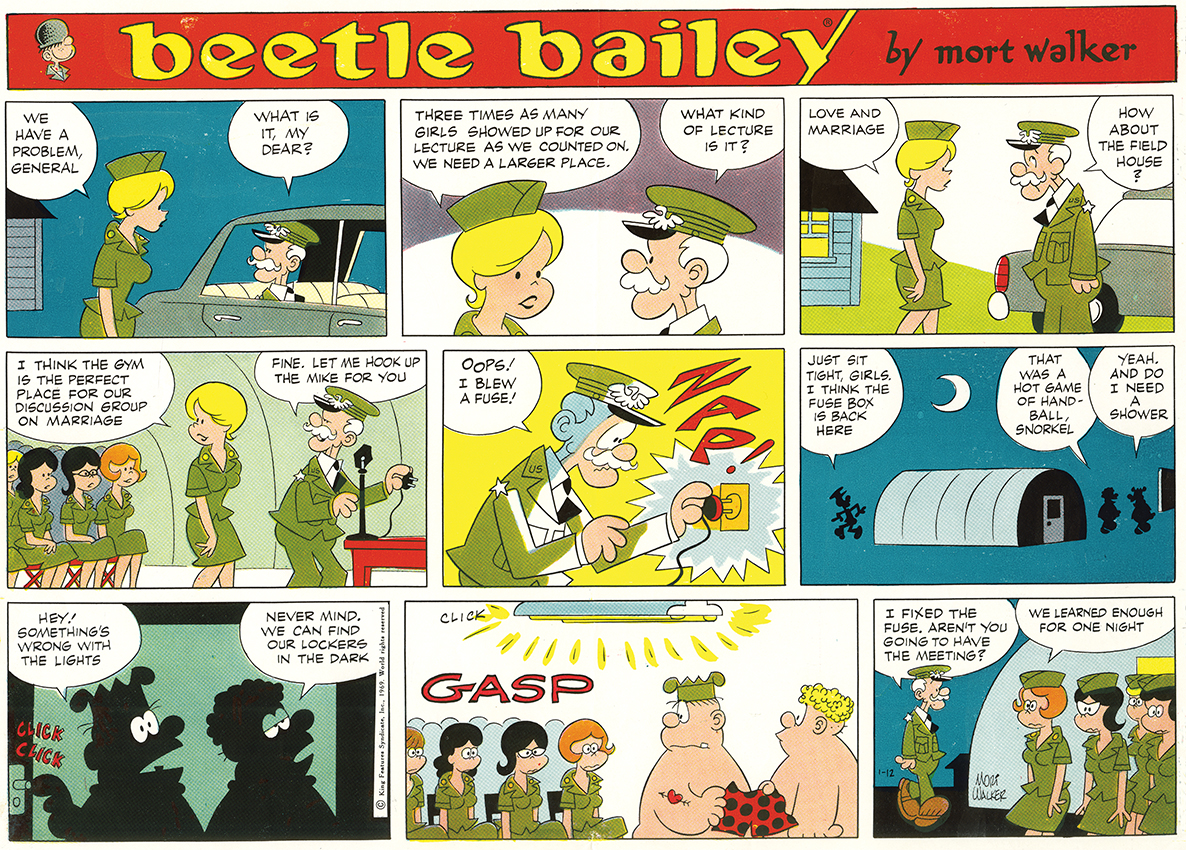
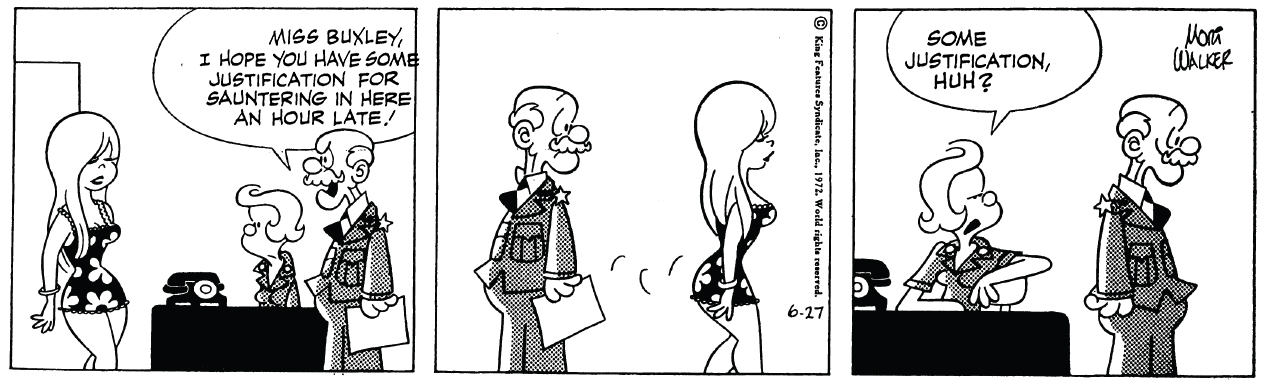
In a clever bit of irony, Beetle Bailey has a hopeless yearner of its own in Gen. Amos T. Halftrack—the guy at the top of the pecking order. He’s miserably married, shunned by the Pentagon and slavishly in lust with Miss Buxley. He tries not to let his lust make a fool of him, but the effort always backfires: “She’s just my receptionist, an ordinary, sweet, young, personable, nice-looking, long-haired, dark-eyed, well-built, soft-skinned, bouncy little …” he says, trailing off in a sexual muddle.
The Halftrack-Buxley gags were among Beetle Bailey’s best—and most controversial. Mort got letters like this: “Do you have a problem, Mr. Walker? Just because you have a penis doesn’t make you superior.” And this: “Have you taken leave of your senses? Get a job with a porn outfit.” “The biggest problem I’ve had in the past is sexism,” Mort once told me, a little wearily. “I tried to be careful. General Halftrack never propositioned her. But he did admire her and look at her. Older men never get tired of looking at pretty girls.”
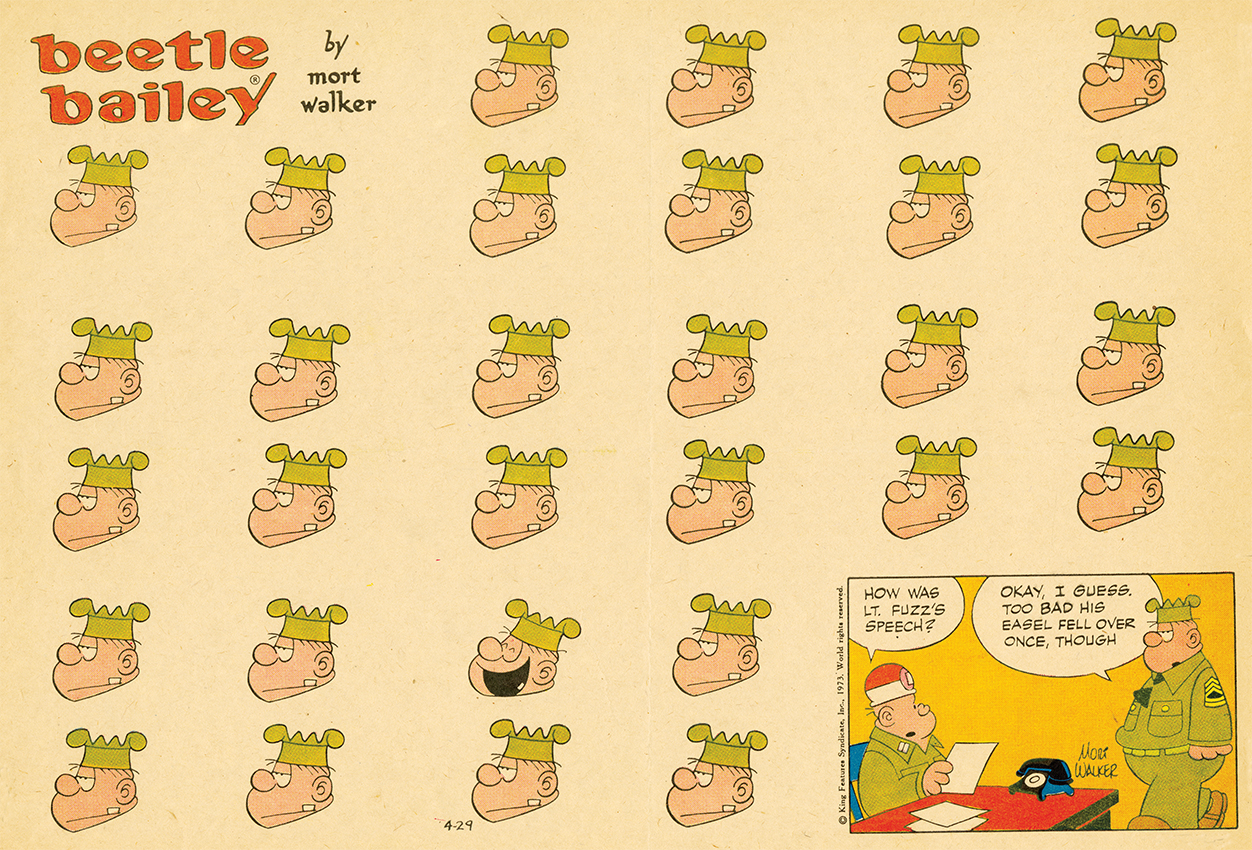
Mike Peters, the Pulitzer-winning editorial cartoonist and creator of the comic strip Mother Goose and Grimm, was fresh from the Army when Miss Buxley sauntered into the strip. “I thought the Miss Buxley gags were wonderful, because I knew exactly how these guys thought,” Peters told me a few years ago. “Then when Mort started getting in trouble for it, I liked them even better. We want to make a little trouble. We want to make people think. We enjoy pushing the envelope and seeing what we can get away with. That’s the fun of being a cartoonist.”
Mort understood the problem of harassment in the workplace—the Miss Buxley uproar hastened this understanding—but he was in the human foibles business. His characters were not supposed to be paragons of virtue.
“If people are going to act that way,” he said of General
Halftrack, “I’m going to draw about it.” (In 1997, under pressure, Mort sent Halftrack to sensitivity training. “I didn’t want to change him,” he admitted, “but it’s worked out all right. I made Miss Buxley Beetle’s girlfriend. She isn’t harassed by the boss anymore—she’s kind of harassing Beetle.”)
MISCHIEF AND MEANING
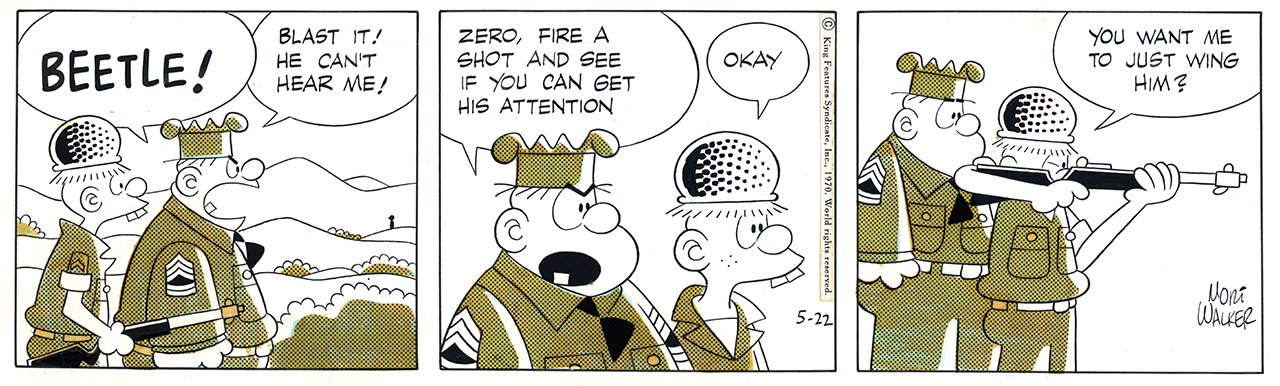
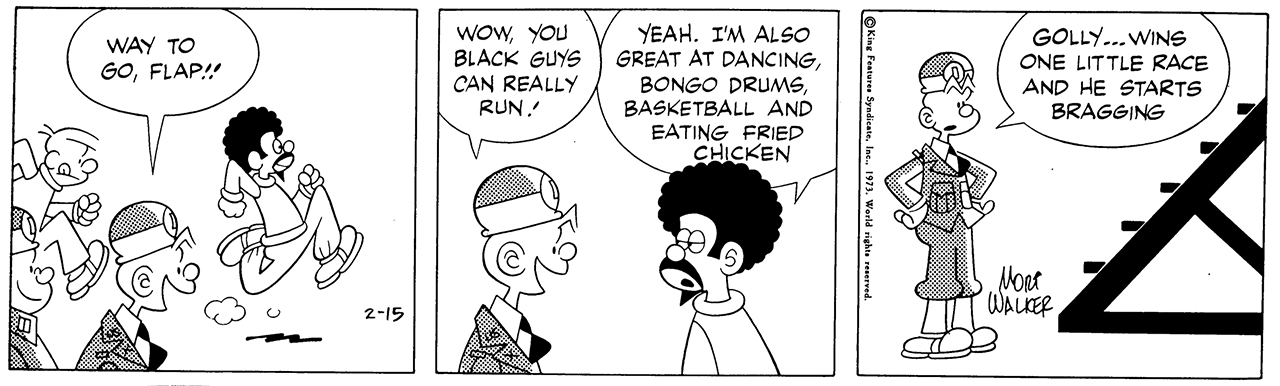
It was the spirit of mischief—the spirit of almost going too far—that I loved best about Beetle Bailey. The strip managed, within the strictly policed confines of the funny pages, to traffic in sex, violence, drinking, cursing, etc., while touching on such delicate themes as religion and race. In 1970, Mort introduced his first black character, Lt. Jack Flap, a soul brother with an afro and an attitude. One gag has Lt. Flap winning a foot race. The obnoxious Lt. Fuzz says, “Wow, you black guys can really run!” Flap replies disdainfully, “Yeah. I’m also great at dancing, bongo drums, basketball and eating fried chicken.” Alone in the last panel, Fuzz says, “Golly … wins one little race and he starts bragging.” The joke is on Fuzz and his casual bigotry—unless you don’t get it.
“Beetle is primarily a humor strip,” Brian Walker says. “It doesn’t have pretensions to be much more than that—although it is.” Garfield creator Jim Davis once told me that Beetle wasn’t a “gag-a-day” strip so much as a human comedy. “It’s all about the relationships between the characters. That’s why Beetle transcends the military. Put him on a desert island, put him in a neighborhood. Doesn’t matter. The main thing is that Mort set up his characters in such a way that there would be a lot of conflict, and out of that comes the humor. That is Mort’s genius.”
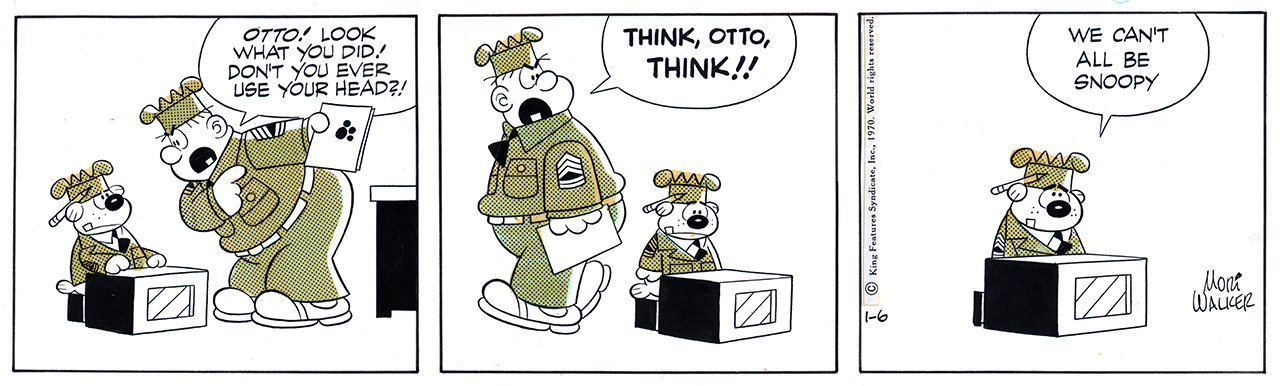
Mort and Jerry dressed Sarge’s dog Otto in a little uniform in 1969. Readers loved it, even if Snoopy was still the comics’ top dog.
Today, Beetle Bailey appears in 1,800 newspapers in
50 countries with an estimated daily readership of 150 million, and ranks among the five most widely read comic strips ever, with Peanuts, Blondie, Garfield and Calvin and Hobbes. The only downside to Beetle’s long-running popularity is a tendency to take it for granted. It’s just always been there. Certainly, I never knew a world without Beetle, Sarge, Killer, Zero, Plato, General Halftrack and the other denizens of Camp Swampy. (Beetle’s spin-off, Hi and Lois, created with Dik Browne in 1954, is equally embedded in me. And I in it: Mort and Dad liberally pillaged their children’s private antics for public fun.)
COMICS IN TRANSITION
In the 80s, a twilightish aura began to settle upon comic strips. Their host medium, the newspaper, was shrinking in number and in size, even before the digital age vastly accelerated the process. Yes, The Far Side, Bloom County, Calvin and Hobbes and a resurgent Doonesbury helped stave off the sense of the reaper. But comics’ “energy” was migrating elsewhere, chiefly to the graphic novel, where ambitious young cartoonists could luxuriate in drawing space and write whatever they wished without worrying about syndicate censors and reader complaints.
Masterpieces like Art Spiegelman’s Maus, Alison Bechdel’s Fun Home and Alan Moore and Dave Gibbons’s Watchmen duly emerged; not coincidentally, the art form once deemed “a menace to public morals” became all the rage among the intellectuals—book publishers, novelists, critics, journal editors, college professors, museum curators. (Here, Mort was ahead of his time: In 1974, he founded the world’s first museum dedicated to cartoon art.) Even the once-lowly superhero—the cheesy comic book of my youth—got reinterpreted as a descendant of Homer.
But the comic strip was largely absent from this critical reckoning. A very few strips did get tapped for study and celebration, chief among them Krazy Kat, Peanuts and Nancy, whose “dumb it down” aesthetic is seen today as a triumph of kitsch, or minimalism, or something. Beetle Bailey inspired no renewed love. Not at first. But as comics scholars (a phrase that cartoonists of old would have hooted at) kept sifting and analyzing, they discovered in Beetle’s golden age an overlooked classic. “I think Beetle is a considerable work of art, but it seems to have been critically neglected,” the late comics historian R.C. Harvey told me a few years ago. Harvey reached this conclusion after careful study of Beetle for his book The Art of the Funnies. “I was surprised, joyfully, at how good it was and at how obtuse I’d been in overlooking it for so many years.”
Mort never made a conscious effort to capture the zeitgeist. Indeed, his soldiers seemed stuck forever in pastoral America while wars in Korea, Vietnam, Afghanistan and Iraq flared and faded. Yet, the authority-tweaking spirit of Beetle Bailey feels newly relevant in our present climate. “Though it may not have felt like it on the surface, Mort Walker’s Beetle Bailey delivered American readers a daily dose of anti-authority humor for decades,” the culture critic Ambrose Tardive wrote last year on the site Screen Rant. “From the formative years of the Cold War, through the Kennedy assassination, Vietnam, Watergate, and every other major event in American history since the midpoint of the 20th century, Beetle Bailey has encouraged readers to push back against authority, even if they often didn’t realize this was the comic’s message.”
Mort wasn’t really a message guy—he was a laugh guy—but I don’t think he would have disagreed too strenuously.
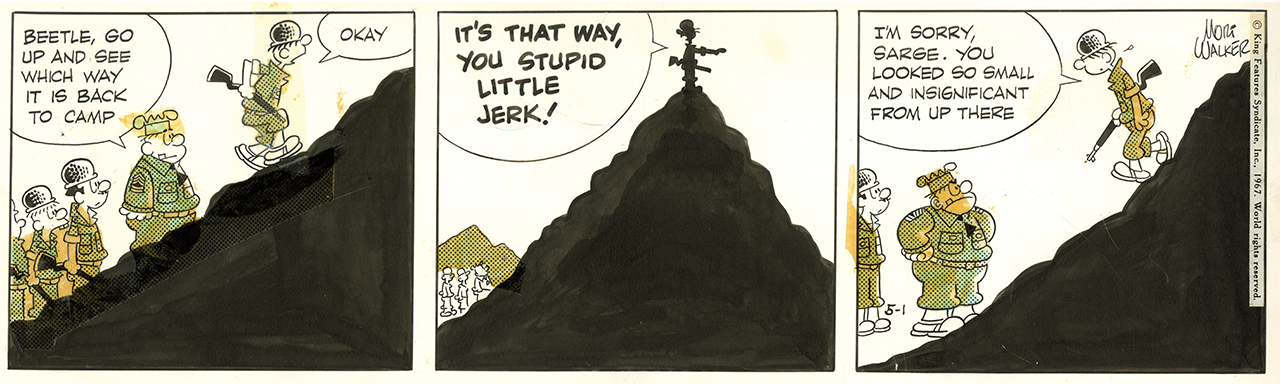
“As a general rule,” he once wrote, “Americans feel that authority should be questioned, not blindly followed, and people in authority accept this resistance as an inalienable right.” (Pregnant pause to reconsider that last bit.) “Beetle and Sarge play the game, Sarge doing his job by imposing authority and Beetle doing his job by resisting it.”
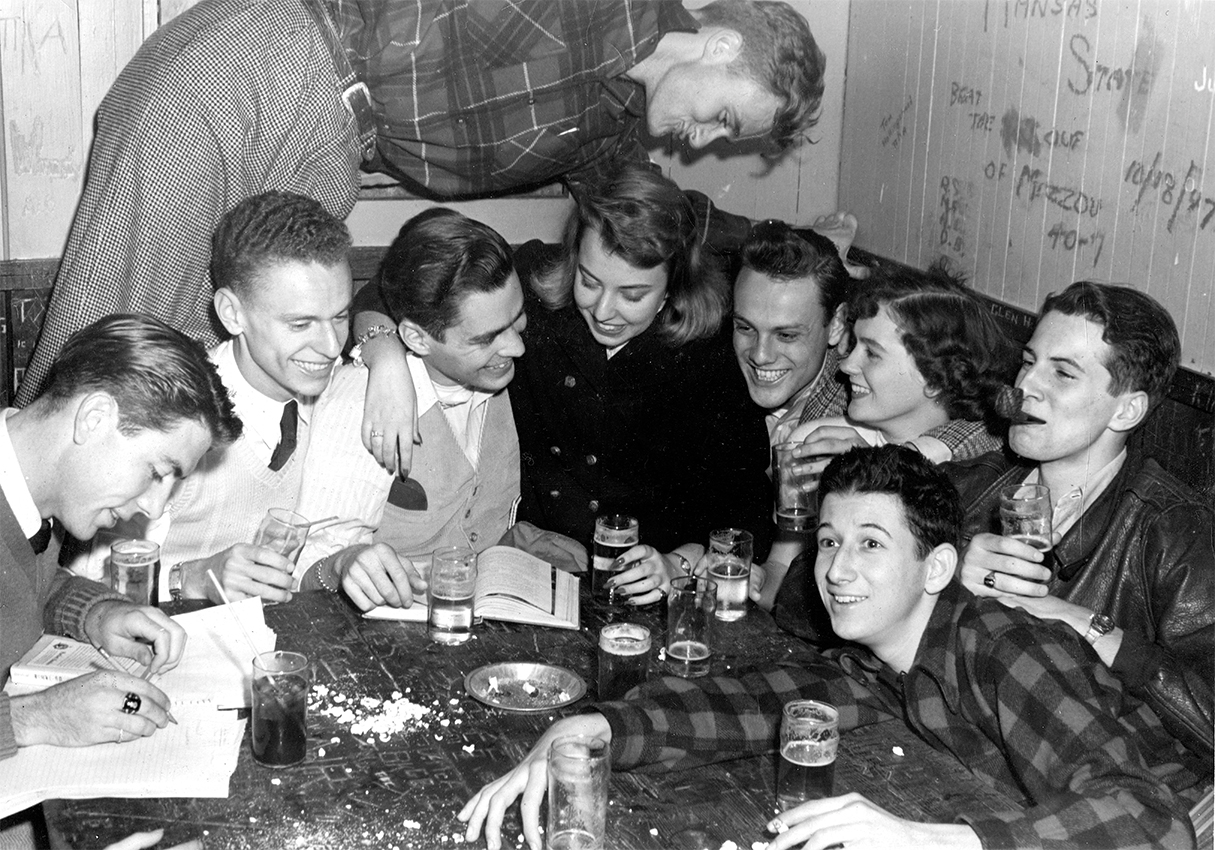
of course. Jean, his first wife, is at the far right.
THE LEGACY MARCHES ON
This year, the 75th anniversary of Beetle Bailey, has seen the publication of three seriously funny Mort Walker-related books
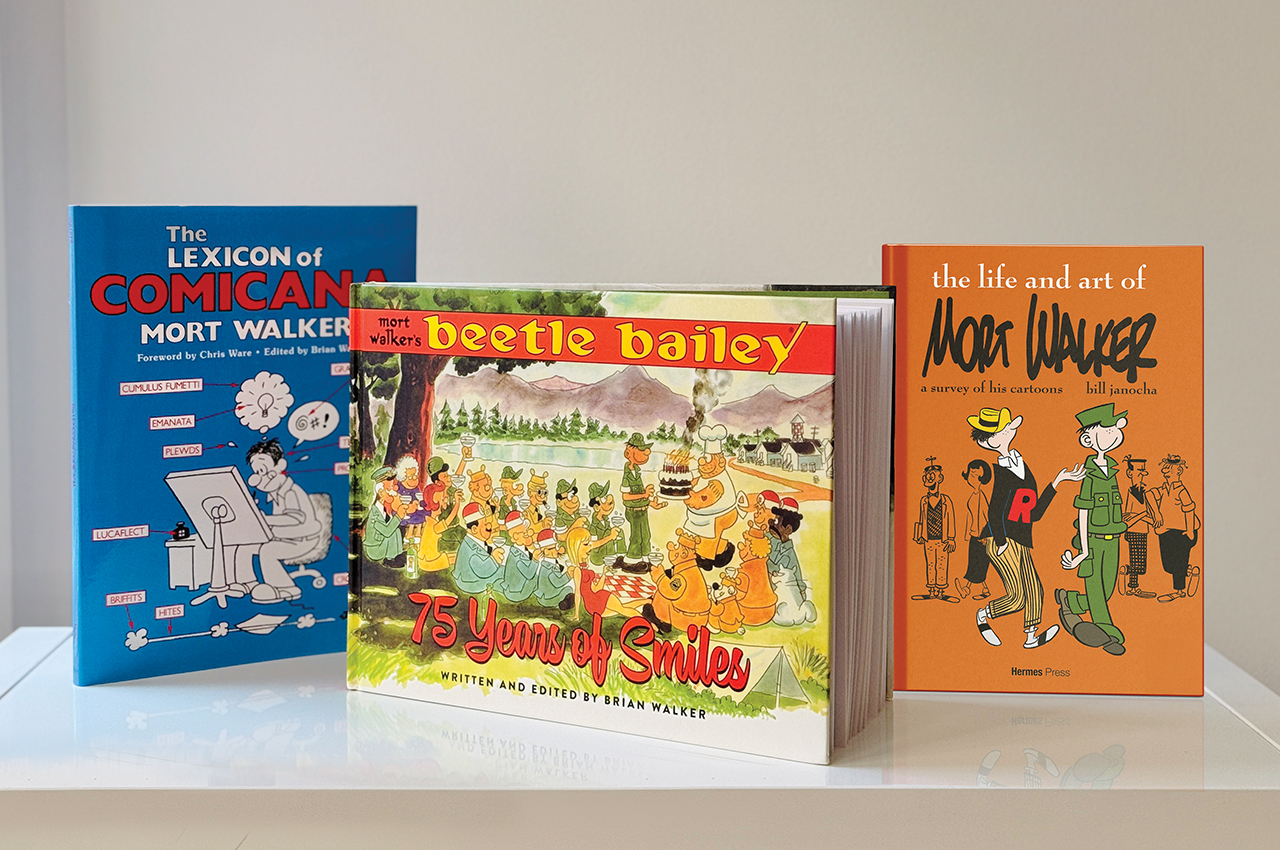
left: The Lexicon of Comicana (The New York Review of Books, $27.95), by Mort Walker, edited by Brian Walker with a foreword by Chris Ware. Mort’s guide to the unique language of the comics, in which we learn the proper terms for dust clouds made by fast feet (briffits), scent lines coming off a hot pie (waftaroms) and drops of sweat leaping from an anxious brow (plewds). Mort originally published The Lexicon in 1980 as an elaborate joke, but young cartoonists took it up with ardor. One of them was Chris Ware, the celebrated graphic novelist and New Yorker cover artist, who writes in his foreword that The Lexicon began “to define comics as its own distinct mother tongue.”
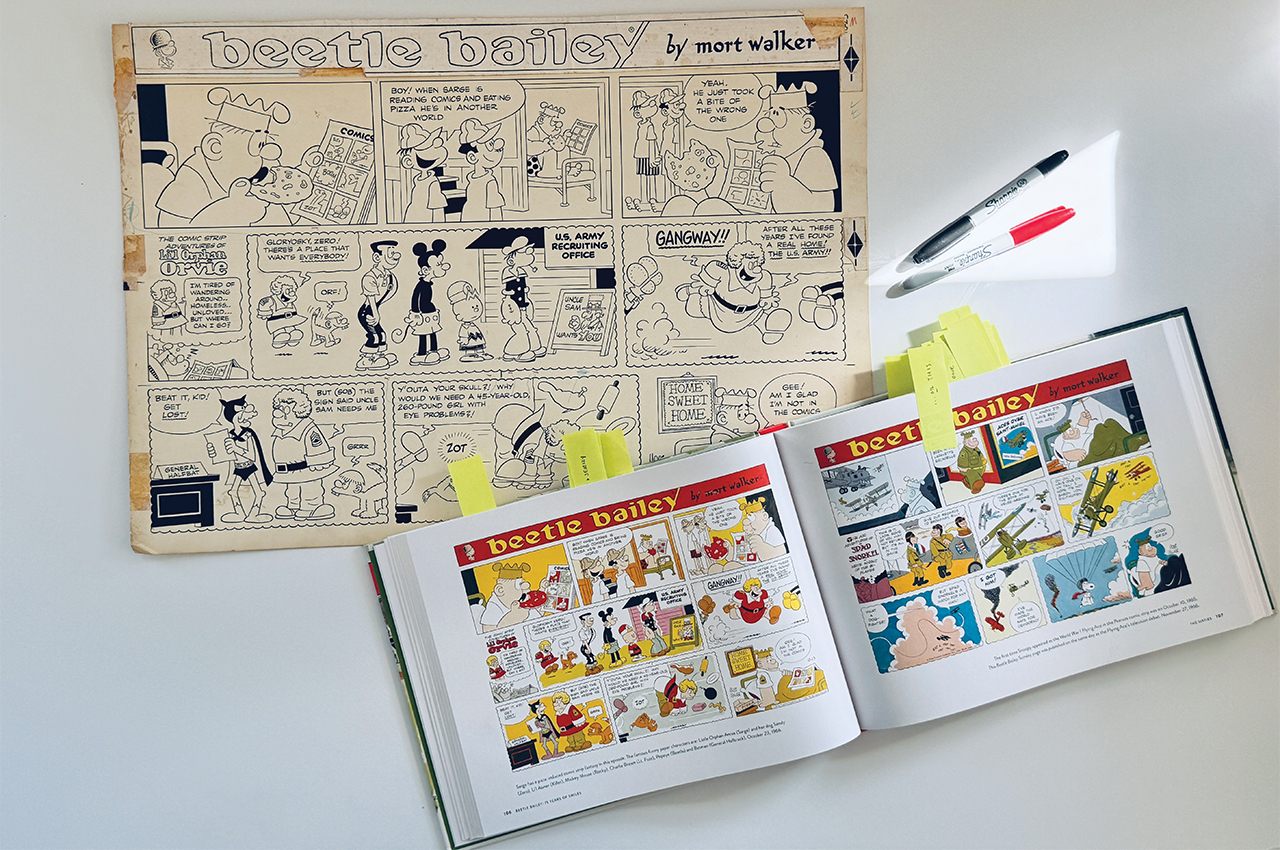
center: Mort Walker’s Beetle Bailey: 75 Years of Smiles (Fantagraphics, $65), written and edited by Brian Walker. Featuring beautifully reproduced daily strips and color Sunday pages, along with photographs, memorabilia and a Miss Buxley centerfold. And, er, a Sarge centerfold.
right: The Life and Art of Mort Walker (Hermes Press, $60), by Bill Janocha, Walker’s longtime assistant. Janocha spent nine years researching, writing and assembling this book, which focuses on Mort’s younger years as a top-selling gag cartoonist for such magazines as The Saturday Evening Post.